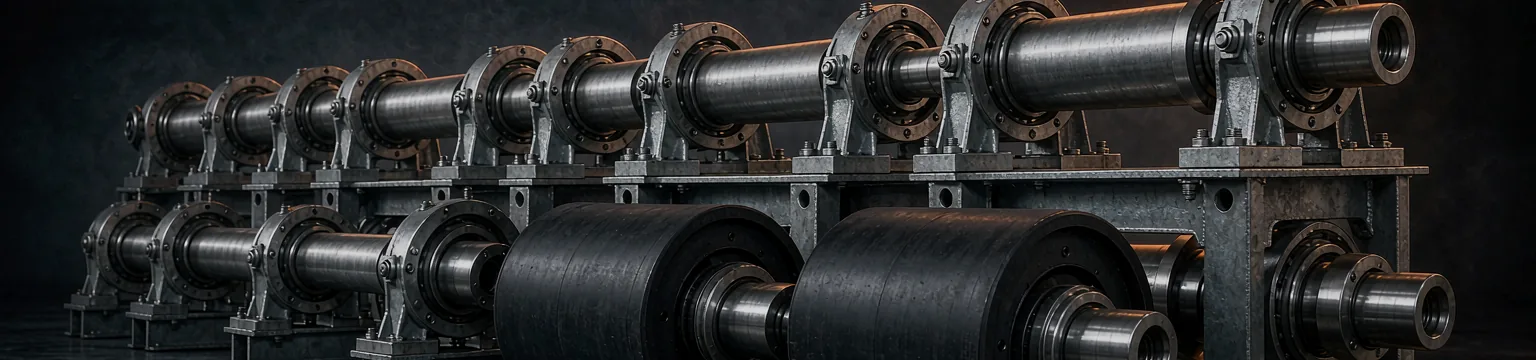
Steel Cord Conveyor Belts Long Distance and High Tension
Steel cord conveyor belts from 630 to 5400 N/mm for long overland conveyors and high tension. Low elongation, hot vulcanised splicing, DIN and RMA grades.
A steel cord belt carries parallel steel cables in place of fabric plies. That gives it very high tensile strength in a thin, low-elongation belt, which is what makes long overland conveyors possible - a fabric belt would stretch too much over the distance and would need take-up travel that no tower can provide.
The trade is at the joints and at the pulleys. A steel cord belt cannot be mechanically fastened, so every joint is a hot vulcanised or stepped splice. And it cannot accept the tight bend a fabric belt takes, so the pulley diameters referred to in pulley tables are minimums, not suggestions.
What You Are Actually Getting
| Parameter | Specification |
|---|---|
| Tensile range | 630 - 5400 N/mm |
| Carcass | Parallel steel cords embedded in rubber |
| Elongation | Very low compared with fabric - this is the reason it is used on long overland runs |
| Splice | Hot vulcanised, or stepped / finger splice. Mechanical fasteners are not applicable |
| Cover grades | To DIN 22102 / ISO 14890 - see the grade table below |
| Minimum pulley diameter | Set by the cord construction, and larger than a fabric belt at the same width. Never specify below the belt maker's minimum |
| Application | Long overland conveyors, high tension, low elongation required, high capacity over distance |
| Standards | DIN 22131 / ISO 15236 for steel cord, plus AS 1332, JIS K 6322 or RMA grades depending on destination |
Cover Grade: Which Letter Do You Need?
The cover grade is independent of the cord construction. A steel cord belt still needs the right cover for what it carries - the most common upgrade on iron ore and hard rock is from Y to W.
| DIN 22102 | ISO 14890 | Abrasion loss (max) | Tensile (min) | What it is for |
|---|---|---|---|---|
| Y | L | 150 mm3 | 20 MPa | General service - the default where neither heavy abrasion nor sharp impact dominates |
| W | D | 90 mm3 | 18 MPa | High abrasive wear: fine to medium ore, crushed rock, cement |
| X | H | 120 mm3 | 25 MPa | Abrasion plus the best cut, gouge and impact resistance - sharp or heavy lump at a high drop |
| Z | - | 200 mm3 | 15 MPa | Mild, non-abrasive duty where cover cost matters more than cover life |
Abrasion loss and tensile are the two numbers that identify the grade across DIN, ISO, AS and JIS systems. Quote the letter plus the cover thickness, for example EP-style notation ST 1600 8+4 X.
Three Decisions That Belong at Specification
Cord strength, not width
Steel cord belts are specified by tensile rating in N/mm, not by belt width alone. Width follows the capacity; tensile follows the tension the drive has to transmit over the distance.
Pulley diameters are minimums
This is where steel cord belts get damaged at specification stage. The cord cannot accept the bend a fabric belt takes, so the drive, tail and bend pulleys all have to be larger. Check every pulley on the route, not just the drive.
Splice determines the joint strength
A stepped or finger splice reaches up to 100 % of belt strength; a mechanical fastener reaches 50 to 70 % and is not applicable to steel cord at all. The splice plan has to be decided with the belt, not after it arrives.
Cover grade is separate
A high-tensile belt with a Y cover on iron ore will wear out the cover long before the cord is exhausted. The two specifications are independent and both have to be right.
Storage and handling
Steel cord belts are heavy and the cords do not like being kinked. Coiling diameter and handling at site decide whether the belt arrives sound - that is a logistics conversation, so raise it before shipment.
Where Steel Cord Is the Only Answer
- Long overland conveyors — Beyond roughly a kilometre, fabric belt elongation makes the take-up impractical. Steel cord is the standard solution.
- High tension, high capacity — Where a single flight has to carry a large tonnage over distance. The tensile range runs to 5400 N/mm.
- Low elongation requirement — Process lines where belt stretch has to stay predictable, such as in long inclined drifts.
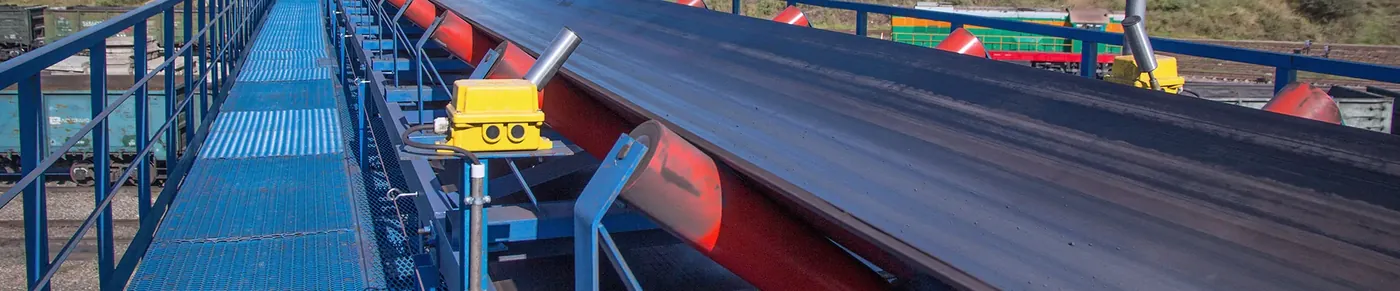
Steel Cord Conveyor Belts FAQ
Can a steel cord belt be mechanically spliced?
No. Mechanical fasteners reach only 50 to 70 % of belt strength on a fabric belt and are not applicable to steel cord at all. Every joint is hot vulcanised or stepped.
Does a steel cord belt need larger pulleys?
Yes. The cord construction sets a minimum bend diameter, and it is larger than for a fabric belt of the same width. Every pulley on the route has to be checked against it.
What cover grade should I choose?
W is the most common upgrade on iron ore, crushed rock and cement. X where the lump is sharp or the drop is high. Y where neither abrasion nor impact dominates. Z only where cover cost matters more than cover life.
What does the number after ST mean?
It is the tensile rating in N/mm - the strength of the belt across its full width. An ST 1600 belt is rated 1600 N/mm. Width and rating are specified separately, because the same rating is available at several widths.
How Orders Run
T/T — 40% deposit with order, 60% balance before shipment. L/C at sight accepted for container orders.
Quoted per order. The schedule depends on the drawing, the quantity and the material — we state a firm date with the quotation instead of a catalogue figure.
15 months from B/L date against manufacturing defects. Claims supported by photos and batch number.
Packing, minimum order and Incoterms are set out in full on the quotation page.
Steel Cord Conveyor Belts Built to Your Drawing
Send the belt width, the duty and, if you have one, the drawing. We will specify it, quote within 24 hours, and ship samples in 2–3 days.
Talk to Our Engineers