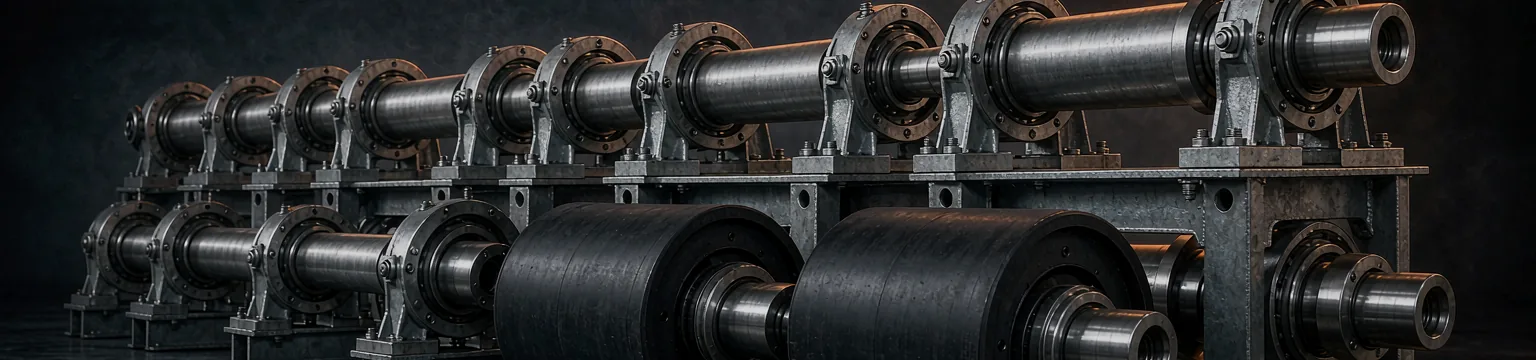
Idler Frames and Brackets Rigid, Garland, Impact, Return and Self-Aligning
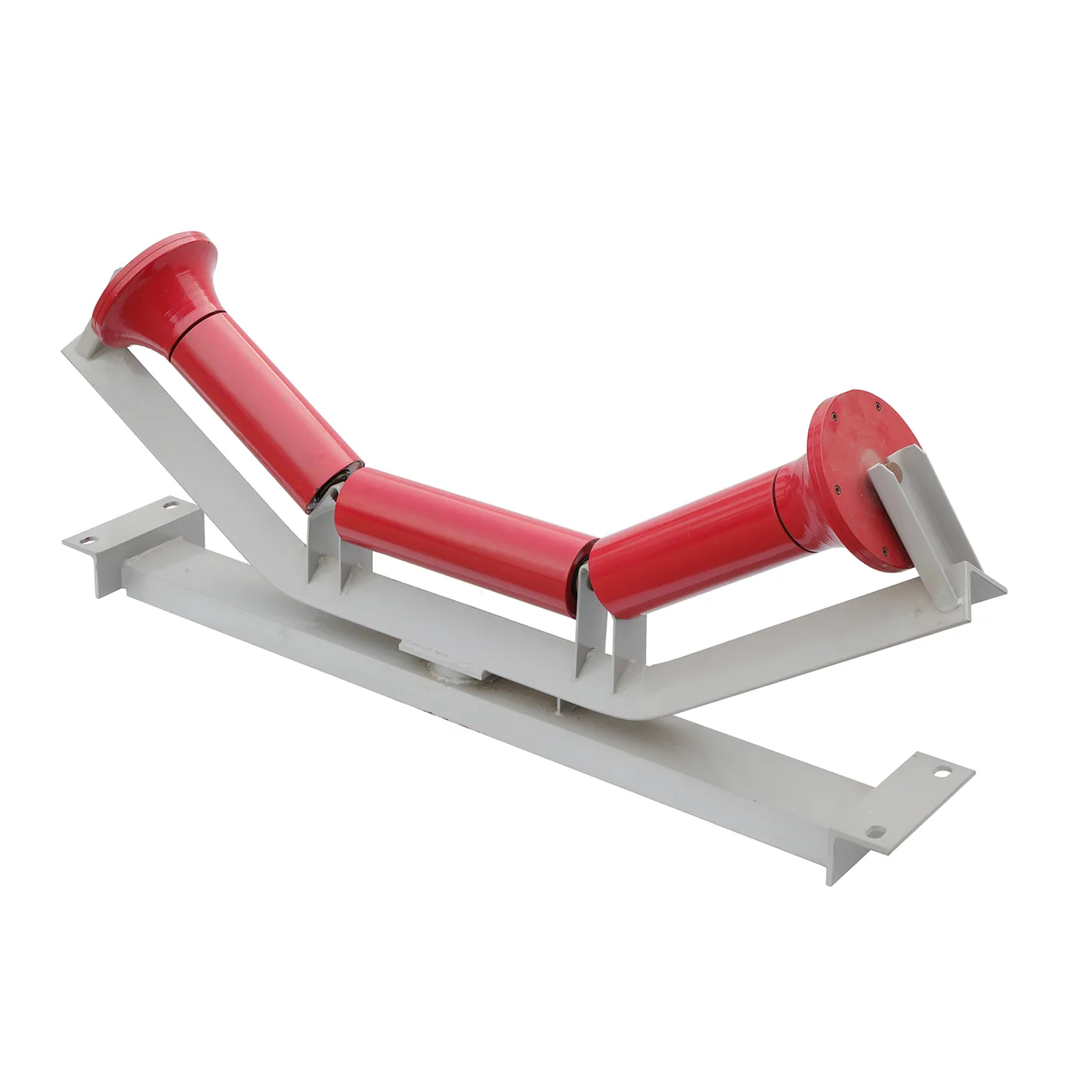
Idler frames and brackets in rigid troughing, garland, impact, return and self-aligning designs. Q235B steel, matched to belt width from 500 to 2000 mm.
An idler frame holds the rollers at the correct trough angle and at the correct height relative to the belt line. It looks like the least interesting part of a conveyor, but frame geometry is what decides whether the belt tracks: a frame out of square by a millimetre per metre will walk the belt into the structure no matter how good the rollers are.
The five frame families exist because the same geometry has to work in different conditions. A rigid troughing frame is the default. Garland frames tolerate a settled foundation, impact frames survive the loading point, return frames hold the return roll square, and self-aligning frames pivot to correct tracking.
What You Are Actually Getting
| Parameter | Specification |
|---|---|
| Frame families | Rigid troughing (20 / 35 / 45 deg), garland / flexible, impact, return, self-aligning |
| Steel | Q235B to GB/T 700, 235 MPa minimum yield, 27 J impact at +20 C. Equivalents: S235JR (EN 10025-2), SS400 (JIS G 3101), A36 (ASTM A36) |
| Belt width range | 500 - 2000 mm in the standard series |
| Finish | Painted, or hot-dip galvanized for outdoor and wash-down duty |
| Squareness | Frame square to the belt centre line within 1 mm per 1 m of belt width |
| Level | Stringer level across the station within 2 mm |
| Roller height | Roller top height station to station within 2 mm over 10 m |
| Assembly | Supplied as loose frames or as pre-assembled sets with the rollers fitted |
Belt Width to Frame Series
The frame series sets the carrying and return roller lengths and the stringer that goes with it. If you are replacing frames, matching this table is faster than measuring worn parts.
| Belt width | Frame series | Carrying roller length | Return roller length | Typical stringer |
|---|---|---|---|---|
| 500 mm | B500 | 190 / 200 mm | 600 mm | Channel 10# / 100 mm |
| 650 mm | B650 | 250 mm | 750 mm | Channel 12# / 120 mm |
| 800 mm | B800 | 315 mm | 950 mm | Channel 14# / 140 mm |
| 1000 mm | B1000 | 380 mm | 1150 mm | Channel 16# / 160 mm |
| 1200 mm | B1200 | 465 mm | 1400 mm | Channel 18# / 180 mm |
| 1400 mm | B1400 | 530 mm | 1600 mm | Channel 20# / 200 mm |
| 1600 mm | B1600 | 600 mm | 1800 mm | Channel 22# / 220 mm |
| 1800 mm | B1800 | 670 mm | 2000 mm | Channel 25# / 250 mm |
| 2000 mm | B2000 | 750 mm | 2200 mm | Channel 28# / 280 mm |
Carrying roller length is nominal; the actual face length follows the trough angle and the frame series together. Outside 500 - 2000 mm, frames are built to drawing.
Three Tolerances That Decide Belt Tracking
Square to the centre line
Within 1 mm per metre of belt width. Miss it and the belt pulls to one side along the whole run, wearing one edge flank. This is the tolerance most often missed on site, and it is a frame problem, not a roller problem.
Stringer level
Within 2 mm across the station. Out of level means the rollers in one set carry unequal load, and the most heavily loaded one wears out first - which is why one roller per set always seems to fail before the others.
Roller top height
Within 2 mm over 10 m, station to station. A run of stations set at slightly different heights makes the belt ripple, spills material and makes idlers bounce.
Rigid or garland
Rigid for a sound foundation and a normal conveyor. Garland where the foundation settles, the conveyor is rope-strung, or impact would destroy a rigid frame - at the cost of load capacity and higher-speed suitability.
Impact frames
Only in the impact zone, where they carry impact rollers at close spacing. Using an impact frame line-wide is expensive and buys nothing outside the loading point.
Matching the Frame to the Job
- Fixed conveyors on a sound foundation — Rigid troughing frames in 20, 35 or 45 degrees. Lowest cost per station and the simplest to align.
- Settling or rope-strung structures — Garland frames. Rollers self-seat and are quick to change without tools, but the frame is not for very high belt speeds.
- Loading and transfer points — Impact frames carrying impact rollers or an impact bed at close spacing.
- Conveyors that will not track — Self-aligning frames pivot to steer the belt back. Note that they mask an alignment problem rather than curing it - square the structure first.
Idler Frames and Brackets FAQ
Do I need to replace frames when I replace rollers?
Not always, but check the squareness and the roller top height before fitting new rollers into old frames. New rollers in an out-of-square frame will wear exactly like the old ones.
What does Q235B mean?
A Chinese structural steel to GB/T 700 with 235 MPa minimum yield and 27 J impact at +20 C. It is broadly equivalent to S235JR in EN 10025-2, SS400 in JIS G 3101, and commonly substituted for ASTM A36, though A36 is rated 250 MPa and has no default impact requirement.
Painted or galvanized?
Painted indoors. Hot-dip galvanized outdoors, in ports and anywhere with wash-down - the frame is the part that rusts first because it holds water in its corners.
Can you supply frames and rollers together?
Yes, pre-assembled to the frame series. That is the safer route, because roller face length only works if the frame series matches it, and a mismatch is not obvious until installation.
How Orders Run
T/T — 40% deposit with order, 60% balance before shipment. L/C at sight accepted for container orders.
Quoted per order. The schedule depends on the drawing, the quantity and the material — we state a firm date with the quotation instead of a catalogue figure.
15 months from B/L date against manufacturing defects. Claims supported by photos and batch number.
Packing, minimum order and Incoterms are set out in full on the quotation page.
Idler Frames and Brackets Built to Your Drawing
Send the belt width, the duty and, if you have one, the drawing. We will specify it, quote within 24 hours, and ship samples in 2–3 days.
Talk to Our Engineers