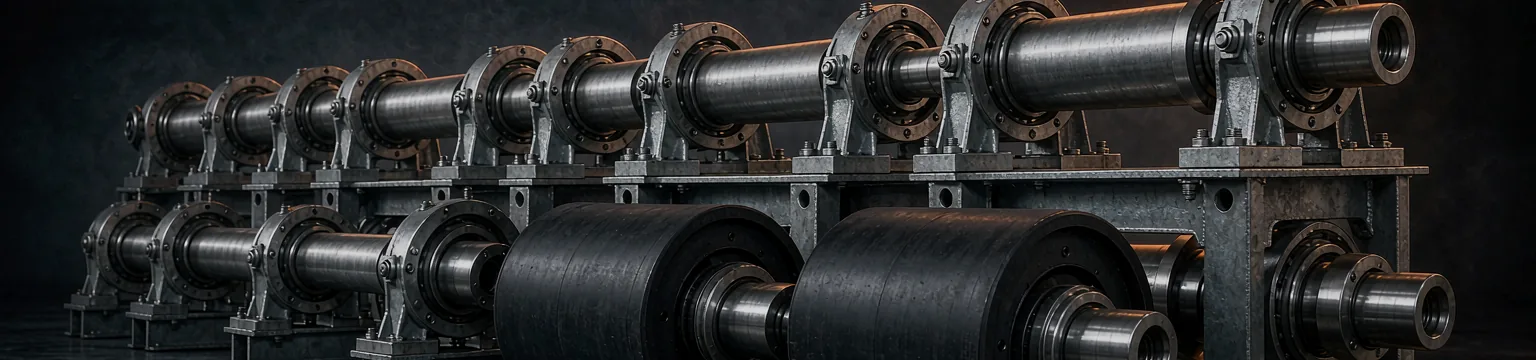
Impact Rollers and Impact Idlers For the Stations Directly Under the Chute
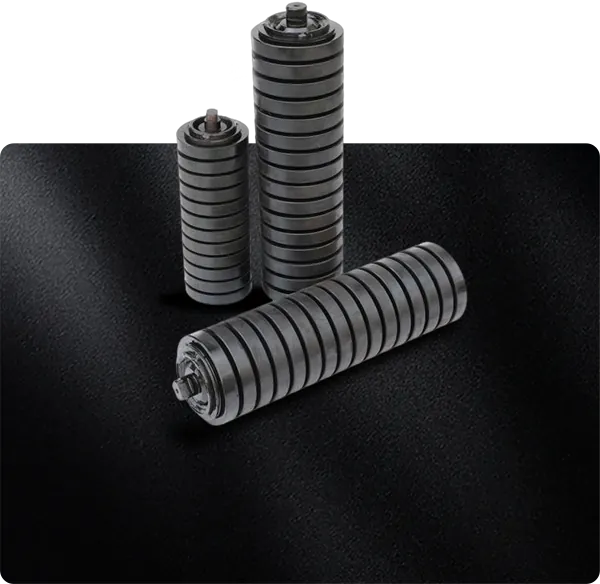
Impact rollers with rubber rings for conveyor loading points. Absorb lump impact, protect belt and splice. Belt widths 400-2400 mm, built to your drop.
An impact roller is a return of the same idea as a troughing roll, with the steel face replaced by a stack of rubber rings. The rings deflect under a lump, spreading the impact over a longer arc of belt instead of letting it land on one hard point. That is the whole function: convert a point load into a distributed load before the belt carcass sees it.
Impact damage does not usually show at the loading point. It shows up later as a cracked carcass, a failed splice, or a belt that starts to delaminate around the impact zone. By then the chute has been running for months. This is why the impact zone is specified by drop height and lump size rather than by belt width alone.
What You Are Actually Getting
| Parameter | Specification |
|---|---|
| Roll diameter | 89.1 / 114.3 / 139.8 / 165.2 mm standard; larger diameters to drawing for heavy lump |
| Ring material | Rubber rings, straight or spiralled around the shell, bonded to the steel tube |
| Ring hardness | Selected against lump size and drop height - tell us the drop and we match the ring |
| Tube | Q235 steel, heavy wall on impact duty |
| Shaft | 45# steel, equivalent to DIN C45 / JIS S45C / AISI 1045 |
| Bearing | Deep-groove ball, C3 standard, C4 for hot or heavy shock duty. HRB or ZWZ standard, SKF or FAG on specification |
| Seal | Grease-retaining inner seal plus multi-stage labyrinth - impact duty drives dust into the bearing harder than any other station |
| Zone length | Typically the first two to three stations below the chute, extending until the material stream has settled |
Impact Roller Sizing Against Belt Width
Impact rolls use the same face length as the carrying station at that belt width, so the table below is the same reference. What changes is the roll face, the wall thickness and the bearing clearance.
| Belt width | Roll dia. | L | Weight (carrying ref.) | Suggested impact stations |
|---|---|---|---|---|
| 400 | 89.1 | 145 | 5.9 | 2 |
| 500 | 89.1 | 180 | 6.5 | 2 |
| 600 | 89.1 | 210 | 8.7 | 2 - 3 |
| 750 | 114.3 | 265 | 11.4 | 2 - 3 |
| 900 | 114.3 | 315 | 12.6 | 2 - 3 |
| 1050 | 139.8 | 370 | 20.6 | 3 |
| 1200 | 139.8 | 420 | 22.3 | 3 |
| 1400 | 165.2 | 500 | 44.1 | 3 |
| 1600 | 165.2 | 580 | 49.9 | 3 - 4 |
| 1800 | 165.2 | 650 | 63.3 | 3 - 4 |
| 2000 | 165.2 | 730 | 67.6 | 4 |
| 2200 | 165.2 | 800 | 93.5 | 4 |
| 2400 | 165.2 | 880 | 100.8 | 4 |
Dimensions in mm. Weight column is the plain steel carrying roll at that width, for reference only - the rubber-ring roll is heavier. Station count is a starting point; it extends until the material stream has settled.
What Actually Breaks at a Loading Point
Belt carcass, not the roller
The impact roller is the cheap part. A punctured carcass or a failed splice costs a shutdown. The rings exist to protect the belt, so ring hardness should be chosen against the lump, not against the price.
Ring stack against lump size
A single large rubber ring deflects less than a stack of narrower rings under the same lump. On large lump, more rings of smaller section is the better build.
Spiralled versus straight rings
Straight rings leave a straight contact line and can trap fines in the gaps. Spiralling the stack moves the contact line continuously, which sheds material instead of packing it.
Bearing clearance
Impact plus heat is the worst combination for a bearing. C4 clearance where the material is hot, and never a C2 here whatever the price difference.
Frames and impact beds
Above a certain drop height no roller survives - an impact bed with rubber bars spreads the load across the full belt width instead. The two are complementary: rollers for moderate drop, a bed where the drop is severe.
Where Impact Rollers Are Specified
- Transfer points — The primary case. Every chute that drops material more than about a metre onto the belt needs a protected impact zone.
- Crusher discharge — Large, sharp, heavy lump at an uncontrolled drop. Impact rollers here, and check the belt cover grade as well - see the heat resistant and DIN X belt pages.
- Mobile and portable plant — Short conveyors with a high drop relative to belt width. The impact zone can be a large fraction of the whole conveyor, which makes the ring choice matter more than usual.
Impact Rollers and Impact Idlers FAQ
How many impact rollers do I need?
Typically two to four stations, starting directly under the chute and continuing until the material stream has settled. The number follows the drop height and the lump size, not the belt width alone. Send us the drop height and the maximum lump and we will give you a zone length.
Impact roller or impact bed?
Rollers where the drop is moderate and the material is not extremely sharp. An impact bed with rubber bars where the drop is severe, the lump is large, or the belt is a steel cord construction that cannot tolerate a point load. The bed costs more and is harder to service, which is why it is not the default.
Will an impact roller stop belt damage completely?
No. It converts a point load into a distributed one and buys life. If the chute geometry is wrong - material landing on the belt edge, or a drop of several metres - no roller will fix it, and the chute needs looking at first.
Can you supply the impact idler set with the frame?
Yes. Complete impact sets, pre-assembled to the frame series you are running, so the face length and the bracket centres are guaranteed to match.
How Orders Run
T/T — 40% deposit with order, 60% balance before shipment. L/C at sight accepted for container orders.
Quoted per order. The schedule depends on the drawing, the quantity and the material — we state a firm date with the quotation instead of a catalogue figure.
15 months from B/L date against manufacturing defects. Claims supported by photos and batch number.
Packing, minimum order and Incoterms are set out in full on the quotation page.
Impact Rollers and Impact Idlers Built to Your Drawing
Send the belt width, the duty and, if you have one, the drawing. We will specify it, quote within 24 hours, and ship samples in 2–3 days.
Talk to Our Engineers