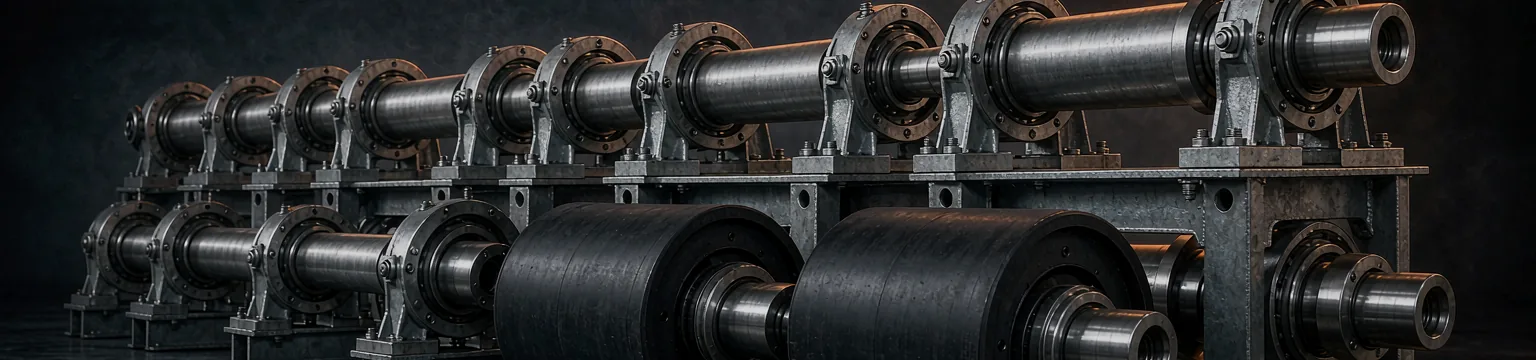
Self-Aligning and Training Idlers Correct Belt Tracking Without External Power
Self-aligning and training idlers that correct belt tracking without power. Friction and tapered designs for carrying and return runs.
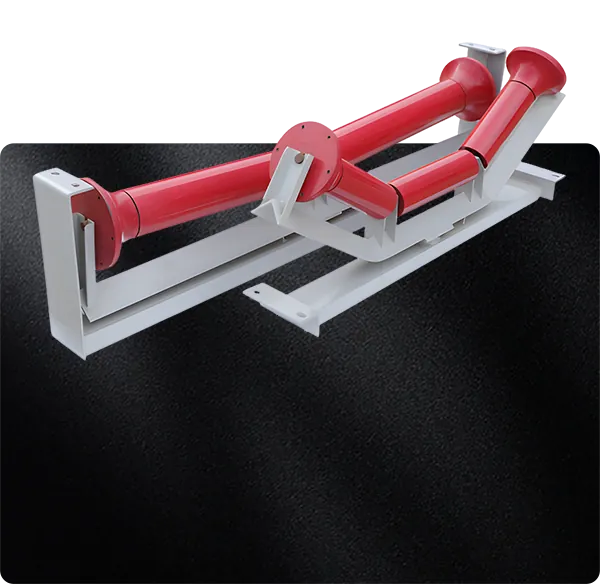
A self-aligning idler, also called a training idler or a tracking idler, pivots on a vertical axis. When the belt drifts to one side it loads the rolls unevenly, the set rotates against its pivot, and the rotation steers the belt back toward centre. There is no motor and no sensor - the correction comes from the geometry of the set.
Naming varies by market and by supplier. Self-aligning idler, self-tracking idler, training idler, and belt tracker all describe the same family. The distinction that actually matters is whether the set is friction-actuated or tapered-roll, and whether it is fitted on the carrying run or the return run.
What You Are Actually Getting
| Parameter | Specification |
|---|---|
| Configuration | Carrying-side self-aligning set, return-side self-aligning set, friction-actuated, or tapered-roll |
| Roll diameter | 89.1 / 114.3 / 139.8 / 165.2 mm standard; to drawing outside that |
| Trough angle | Carrying-side sets follow the trough angle of the line - 20, 30 or 45 deg standard |
| Pivot | Vertical-axis pivot with a limited rotation range; the set self-centres when the belt runs true |
| Tube | Q235 steel, equivalent to SS400 / S275JR |
| Shaft | 45# steel, equivalent to DIN C45 / JIS S45C / AISI 1045 |
| Bearing | Deep-groove ball 6204 - 6310, HRB or ZWZ standard, SKF or FAG on specification |
| Mounting | Same bracket centres as a standard station at that belt width - see the dimension table |
Self-Aligning Set Dimensions by Belt Width
A training set mounts on the same centres as the standard carrying station, so it is a drop-in replacement rather than a rebuild. The H column gives the installed height at each trough angle.
| Belt width | Roll dia. | L | M | H 30 deg | Bolt Z | Weight |
|---|---|---|---|---|---|---|
| 400 | 89.1 | 145 | 690 | 235 | M12 | 5.9 |
| 500 | 89.1 | 180 | 790 | 250 | M12 | 6.5 |
| 600 | 89.1 | 210 | 890 | 280 | M12 | 8.7 |
| 750 | 114.3 | 265 | 1090 | 325 | M12 | 11.4 |
| 900 | 114.3 | 315 | 1240 | 345 | M12 | 12.6 |
| 1050 | 139.8 | 370 | 1390 | 411 | M16 | 20.6 |
| 1200 | 139.8 | 420 | 1540 | 435 | M16 | 22.3 |
| 1400 | 165.2 | 500 | 1790 | 550 | M16 | 44.1 |
| 1600 | 165.2 | 580 | 1990 | 585 | M16 | 49.9 |
| 1800 | 165.2 | 650 | 2280 | 645 | M16 | 63.3 |
| 2000 | 165.2 | 730 | 2480 | 680 | M16 | 67.6 |
| 2200 | 165.2 | 800 | 2680 | 730 | M20 | 93.5 |
| 2400 | 165.2 | 880 | 2880 | 760 | M20 | 100.8 |
Dimensions in mm, weight in kg per set, taken at the 30 degree trough. Training sets are normally installed in pairs, 15 to 25 m apart on a long conveyor.
Training Idlers Fix a Symptom - Check the Cause First
Square the structure first
Most belt tracking problems are an out-of-square frame, an unlevel stringer, or a pulley that is not square to the belt line. A training idler will mask that for a while, then the belt will start wearing the edge again further along the line.
Load the belt before judging
A belt tracks differently empty and loaded. If the belt runs true empty and walks when loaded, the problem is material distribution at the loading point, not the idler. Fix the chute before buying a tracker.
Friction versus tapered
Friction-actuated sets pivot when the belt contacts a roller at an angle, which is the more sensitive arrangement. Tapered-roll sets use differential surface speed, which is more tolerant of poor belt condition but slower to correct.
Placement
Carrying-side training sets go on the return leg of the carrying run, several stations before the point where the belt wanders. Return-side sets go on the return run, ahead of the tail pulley. Installing one directly at the problem point usually corrects too late.
Never at a transition
Do not fit a training set in a transition zone or close to a pulley. The belt curvature there confuses the pivot and the set will fight the belt instead of guiding it.
Where Tracking Correction Is Worth Paying For
- Long overland conveyors — Belt wander accumulates over distance. Two or three training sets spread along the line cost far less than edge damage and spillage over years of running.
- Reversing belts — Tracking has to be corrected in both directions, so the training set must be symmetric. Tell us the belt reverses - it changes the design.
- After a belt replacement — A new belt is rarely perfectly square. A pair of training sets through the first weeks saves the edges while the belt settles.
Self-Aligning and Training Idlers FAQ
What is the difference between a self-aligning idler and a training idler?
Nothing functional - they are two names for the same component, along with self-tracking idler and belt tracker. Suppliers use the terms interchangeably. What varies is the actuation: friction, tapered roll, or a gravity/pivot arrangement.
How many training idlers does a conveyor need?
Commonly one pair on the carrying run and one on the return run for a conveyor of a few hundred metres, spaced 15 to 25 m apart. Short conveyors often need none once the structure is square. It is a correction device, not a substitute for alignment.
Can a training idler damage the belt?
Yes, if it is installed in the wrong place - at a transition, next to a pulley, or where the belt is under tension it cannot relieve. Correctly placed it does no harm, because the pivot only acts when the belt actually pushes against it.
Do you build training sets for reversing conveyors?
Yes. Tell us the belt reverses, because a set built for one direction will steer the wrong way in the other.
How Orders Run
T/T — 40% deposit with order, 60% balance before shipment. L/C at sight accepted for container orders.
Quoted per order. The schedule depends on the drawing, the quantity and the material — we state a firm date with the quotation instead of a catalogue figure.
15 months from B/L date against manufacturing defects. Claims supported by photos and batch number.
Packing, minimum order and Incoterms are set out in full on the quotation page.
Self-Aligning and Training Idlers Built to Your Drawing
Send the belt width, the duty and, if you have one, the drawing. We will specify it, quote within 24 hours, and ship samples in 2–3 days.
Talk to Our Engineers