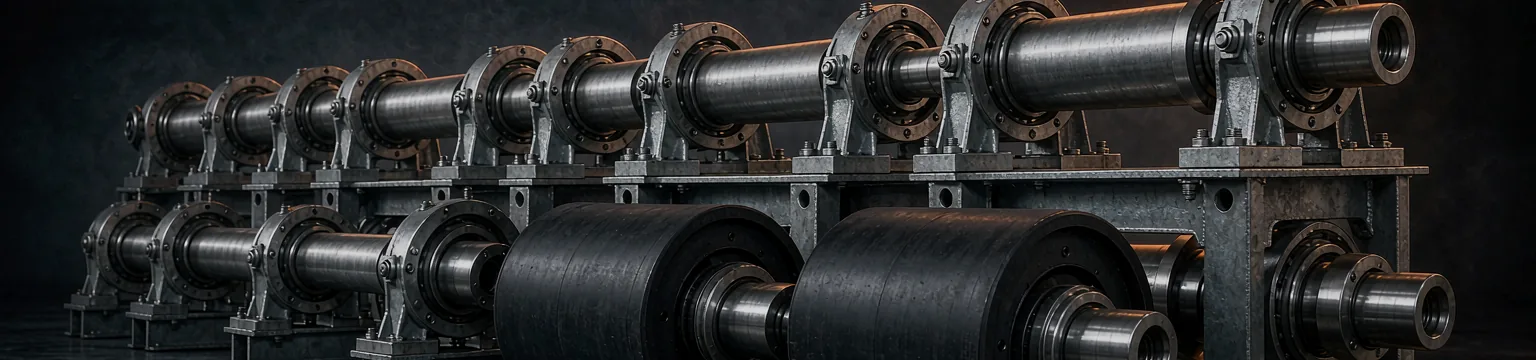
Conveyor Return Rollers Flat, V-Return and Self-Cleaning Idlers
Return rollers and return idlers for belt widths 400-2400 mm. Flat and V-return, plain steel, spiral and rubber disc. Q235 tube, CEMA B-F, built to drawing.
A return roller - also called a return idler - supports the empty belt on its way back to the tail. It carries almost no material load, which makes it the cheapest station on the conveyor - and the one most often specified badly, because the load it does carry is not weight but contamination.
The return side is where carry-back lands. Fines stuck to the belt drop off as the belt turns over, and they drop onto the return rolls. That is why the failure pattern on the return side is seized bearings rather than worn tubes, and why spiral and rubber disc rolls exist at all: both are attempts to shed material instead of letting it pack against the roll face.
What You Are Actually Getting
| Parameter | Specification |
|---|---|
| Roll diameter | 89.1 / 114.3 / 139.8 / 165.2 mm standard; other diameters cut to drawing |
| Roller length (L) | 145 - 880 mm across the standard belt widths; up to 3400 mm to drawing |
| Configuration | Single flat roll, two-roll V-return, or spiral / rubber disc self-cleaning |
| Tube | Q235 steel, equivalent to SS400 / S275JR |
| Shaft | 45# steel, equivalent to DIN C45 / JIS S45C / AISI 1045 |
| Bearing | Deep-groove ball 6204 - 6310, HRB or ZWZ standard, SKF or FAG on specification |
| Grease | Lithium / semi-synthetic with rust inhibitors, continuous service -40 C to +120 C; lithium complex to +160 C for high ambient |
| Standard | GB / DIN / JIS / BS dimensions. We build to the drawing you have, without converting it to a CEMA equivalent first |
Return Idler Dimensions by Belt Width
Return stations use the same roll length as the carrying side at that belt width. m is the mounting dimension between the return bracket centres.
| Belt width | Roll dia. | L | m | n | Weight |
|---|---|---|---|---|---|
| 400 | 89.1 | 145 | 640 | 200 | 5.9 |
| 450 | 89.1 | 165 | 690 | 200 | 6.2 |
| 500 | 89.1 | 180 | 740 | 200 | 6.5 |
| 600 | 89.1 | 210 | 840 | 200 | 8.7 |
| 750 | 114.3 | 265 | 1040 | 220 | 11.4 |
| 900 | 114.3 | 315 | 1190 | 220 | 12.6 |
| 1050 | 139.8 | 370 | 1340 | 180 | 20.6 |
| 1200 | 139.8 | 420 | 1490 | 180 | 22.3 |
| 1400 | 165.2 | 500 | 1730 | 280 | 44.1 |
| 1600 | 165.2 | 580 | 1930 | 280 | 49.9 |
| 1800 | 165.2 | 650 | 2220 | 330 | 63.3 |
| 2000 | 165.2 | 730 | 2420 | 330 | 67.6 |
| 2200 | 165.2 | 800 | 2620 | 330 | 93.5 |
| 2400 | 165.2 | 880 | 2820 | 330 | 100.8 |
Dimensions in mm, weight in kg per roll. V-return and self-cleaning configurations use the same L and mounting dimensions; only the roll face changes.
Which Return Configuration, and When
Plain flat return
Correct when the belt is clean and the material is dry. Cheapest per station and the easiest to replace. Wrong choice on any conveyor with carry-back.
V-return
Two rolls in a shallow V train the belt back to centre as well as supporting it. Used where the belt wanders on the return run, particularly on long conveyors and on belts that are not perfectly square.
Spiral return
A helical wrap on the roll face breaks the contact line so material cannot pack and crush. It also nudges the belt toward centre. The standard answer for sticky or wet carry-back.
Rubber disc return
Discrete rubber discs do the same job with more open area, which suits fibrous or stringy material that would wrap a spiral. Heavier than a spiral roll at the same diameter, so check the bearing load on wide belts.
Return spacing
Return stations are spaced far wider than carrying stations because the load is only the belt itself - commonly 3 m on a 1000 mm belt. Too wide and the belt sags into the structure; too tight and you are paying for idlers that do no work.
The Return Side Is Where Seizures Show Up First
- Cement and clinker — Carry-back is fine and highly abrasive. Use spiral or rubber disc rolls, and expect the bearing to fail before the tube wears through - specify the seal stack accordingly.
- Ports and stockyards — Salt air plus wash-down water. Galvanized or stainless shell, and grease with rust inhibitors as standard.
- Underground coal — Flame-retardant and anti-static requirements apply to the belt, not the idler, but the return station still has to survive wet fines. Sealed-for-life rolls avoid a greasing round you will not get to.
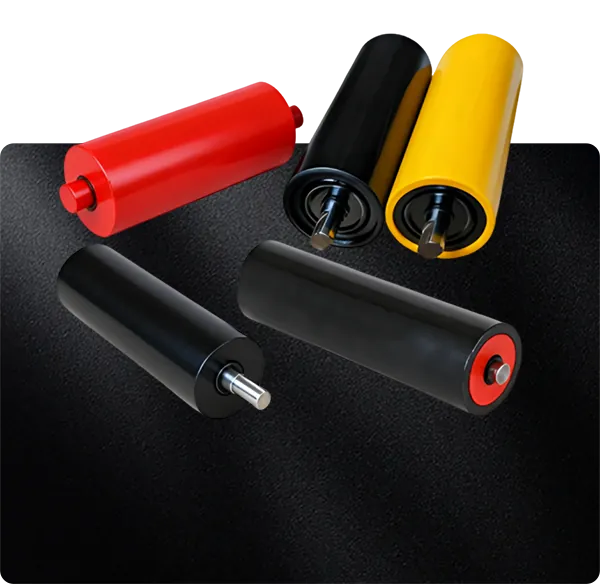
Conveyor Return Rollers FAQ
What is the difference between a return idler and a return roller?
None in practice - both names describe the same component, and both are used interchangeably in tenders. A return idler usually implies the roll with its bearing housing and shaft; a return roller is sometimes used for just the roll body. We build the complete assembly either way.
How far apart should return idlers be?
Roughly three times the carrying idler spacing is the usual starting point, typically around 3 m on a 1000 mm belt, but it has to be checked against belt sag. Send us the belt width and the belt weight per metre and we will give you a spacing that does not sag the belt into the structure.
Do I need a V-return or a flat return?
If the belt tracks well on the return run, flat is enough and cheaper. If it wanders, a V-return corrects it without adding a training idler. Spiral and rubber disc rolls correct track as a side effect of their shape.
Can you match the mounting dimensions of an existing station?
Yes. Send the m and n dimensions from the table above, or send one worn roll and we will reverse-engineer the shaft ends and bearing seat. The mounting dimensions matter more than the tube diameter.
How Orders Run
T/T — 40% deposit with order, 60% balance before shipment. L/C at sight accepted for container orders.
Quoted per order. The schedule depends on the drawing, the quantity and the material — we state a firm date with the quotation instead of a catalogue figure.
15 months from B/L date against manufacturing defects. Claims supported by photos and batch number.
Packing, minimum order and Incoterms are set out in full on the quotation page.
Conveyor Return Rollers Built to Your Drawing
Send the belt width, the duty and, if you have one, the drawing. We will specify it, quote within 24 hours, and ship samples in 2–3 days.
Talk to Our Engineers