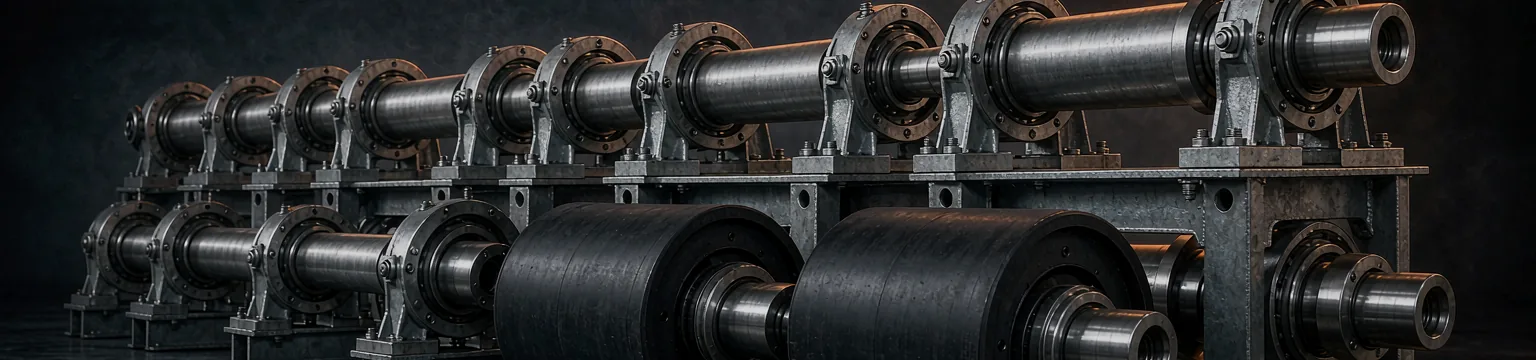
Rubber Disc Return Rollers Open Disc Face That Sheds and Centres
Rubber disc return rollers with spaced discs that shed carry-back and centre the belt. Belt widths 400-2400 mm, built to your mounting dimensions.
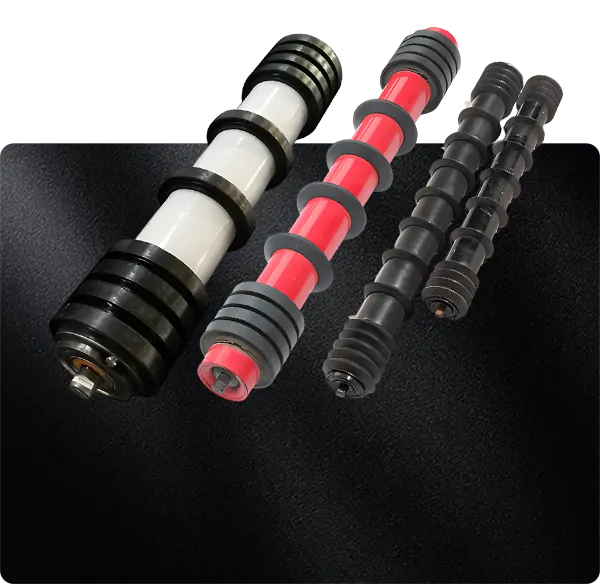
A rubber disc return roller replaces the smooth steel face with a row of rubber discs spaced along the shell. Between the discs there is open space, so material that lands on the face has nowhere to pack and falls away as the roll turns. The discs themselves also deflect slightly under the belt, which spreads the contact and quiets the roll.
Compared with a spiral roller, the disc face is better at handling fibrous or stringy carry-back - the kind that wraps around a helix rather than shedding from it - and worse at handling fine wet dust, where a spiral's continuous wrap sheds more effectively. Choosing between them is a question about what your material actually leaves on the belt.
What You Are Actually Getting
| Parameter | Specification |
|---|---|
| Face | Rubber discs, spaced along the shell, bonded to the steel tube |
| Disc spacing | Set against belt width and carry-back type at build |
| Roll diameter | 89.1 / 114.3 / 139.8 / 165.2 mm standard; to drawing outside that |
| Tube | Q235 steel, equivalent to SS400 / S275JR |
| Shaft | 45# steel, equivalent to DIN C45 / JIS S45C / AISI 1045 |
| Bearing | Deep-groove ball 6204 - 6310, HRB or ZWZ standard, SKF or FAG on specification |
| Seal | Grease-retaining inner seal plus multi-stage labyrinth |
| Mounting | Same bracket centres as a standard return station at that belt width |
Rubber Disc Return Roller Dimensions
Disc rolls use the standard return roll length and mounting dimensions, so they drop into an existing return bracket. The disc stack adds mass - the weight column is the plain return roll for comparison.
| Belt width | Roll dia. | L | m | n | Plain-roll weight |
|---|---|---|---|---|---|
| 400 | 89.1 | 145 | 640 | 200 | 5.9 |
| 500 | 89.1 | 180 | 740 | 200 | 6.5 |
| 600 | 89.1 | 210 | 840 | 200 | 8.7 |
| 750 | 114.3 | 265 | 1040 | 220 | 11.4 |
| 900 | 114.3 | 315 | 1190 | 220 | 12.6 |
| 1050 | 139.8 | 370 | 1340 | 180 | 20.6 |
| 1200 | 139.8 | 420 | 1490 | 180 | 22.3 |
| 1400 | 165.2 | 500 | 1730 | 280 | 44.1 |
| 1600 | 165.2 | 580 | 1930 | 280 | 49.9 |
| 1800 | 165.2 | 650 | 2220 | 330 | 63.3 |
| 2000 | 165.2 | 730 | 2420 | 330 | 67.6 |
| 2200 | 165.2 | 800 | 2620 | 330 | 93.5 |
| 2400 | 165.2 | 880 | 2820 | 330 | 100.8 |
Dimensions in mm, weight in kg. Disc count and spacing are set at build against belt width and carry-back type.
Disc Face: What It Does and Does Not Do
Open area is the mechanism
The gaps between discs are the whole point. If a supplier builds a disc roll with narrow gaps to look heavier, it loses the self-shedding property and behaves like a bad plain roll.
Disc hardness
Softer discs deflect more and quiet the roll, but wear faster under abrasive carry-back. Harder discs last longer and transmit more noise. We match the disc to the material.
Heavier than a spiral
The disc stack is heavier than a helical wrap at the same diameter. On wide belts, check the bearing load rather than assuming the plain roll's bearing is adequate.
Still needs a cleaner
A disc roll copes with residue. It does not replace the primary cleaner at the head pulley, which is where carry-back should be stopped.
Disc damage is visible early
A damaged disc shows as a thump once per revolution, which is easy to diagnose and easy to replace. That is a small advantage over a spiral, where damage is harder to spot.
Where Disc Rolls Beat Spirals
- Recycling and waste — Stringy, fibrous and mixed material. A spiral wraps; a disc sheds.
- Wood chips and biomass — Long fibres that wrap around a helix. Disc spacing is set wider for this duty.
- Sugar, grain and food — Where the material is not aggressive but must not be contaminated by a packed crust of old product.
Rubber Disc Return Rollers FAQ
Rubber disc or spiral return roller?
Disc for fibrous, stringy or long-fibre carry-back. Spiral for fine wet dust. If the carry-back is a mix, tell us what the material is and we will recommend one rather than sell you both.
Are these the same as rubber ring return rollers?
Effectively yes - rubber ring, rubber disc and rubber tyre are all used in the trade for the same face. The differences that matter are disc count, disc spacing and hardness, not the name.
Do the discs wear out before the bearing?
Usually the bearing goes first in fine dust, and the discs go first under abrasive lump. Both are replaceable, but a disc roll is normally replaced as a unit because the discs are bonded to the shell.
Can you match an existing disc roll?
Yes. Send the disc count, the disc diameter and the mounting dimensions, or send one worn roll and we will reverse-engineer it.
How Orders Run
T/T — 40% deposit with order, 60% balance before shipment. L/C at sight accepted for container orders.
Quoted per order. The schedule depends on the drawing, the quantity and the material — we state a firm date with the quotation instead of a catalogue figure.
15 months from B/L date against manufacturing defects. Claims supported by photos and batch number.
Packing, minimum order and Incoterms are set out in full on the quotation page.
Rubber Disc Return Rollers Built to Your Drawing
Send the belt width, the duty and, if you have one, the drawing. We will specify it, quote within 24 hours, and ship samples in 2–3 days.
Talk to Our Engineers