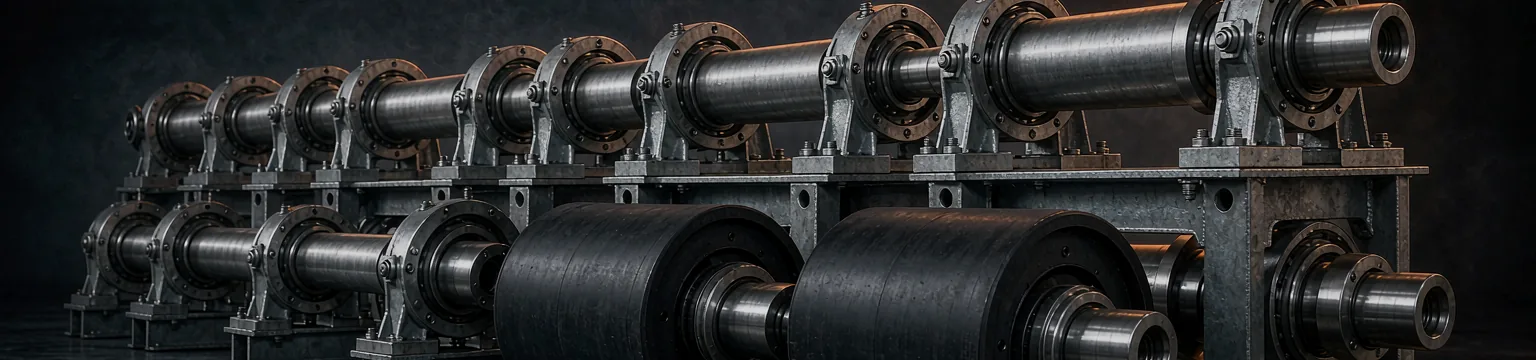
Spiral Return Rollers Self-Cleaning Face for Sticky Carry-Back
Spiral return rollers with a helical face that sheds carry-back and centres the belt. Belt widths 400-2400 mm, Q235 tube, CEMA B-F bearings, built to drawing.
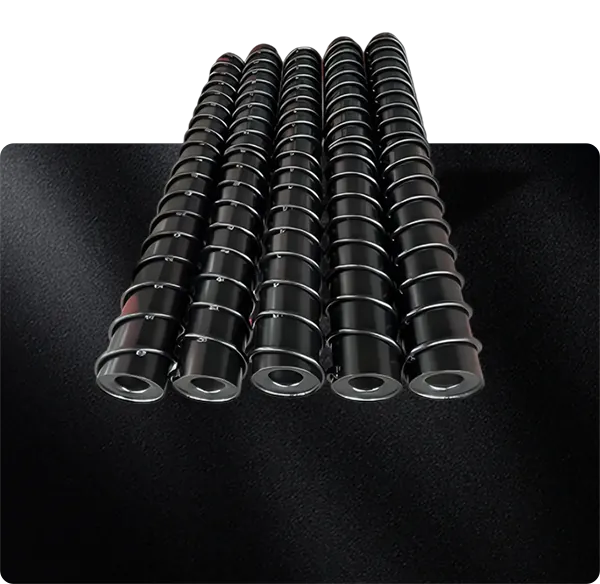
A spiral return roller carries a helical steel wrap around the shell in place of a smooth face. Where a plain roll presents one continuous contact line and lets material pack against it, the spiral presents a line that moves sideways as the roll turns, so material is pushed off the face instead of being crushed into it.
The wrap also does a second job. Because contact with the belt is asymmetric, a spiral roll nudges the belt toward centre as it turns. That is why spiral rollers are often fitted as a partial substitute for a training idler on the return run.
What You Are Actually Getting
| Parameter | Specification |
|---|---|
| Face | Steel spiral wrap welded to the shell, right-hand or left-hand helix |
| Roll diameter | 89.1 / 114.3 / 139.8 / 165.2 mm standard; to drawing outside that |
| Roller length (L) | 145 - 880 mm across the standard belt widths |
| Tube | Q235 steel, equivalent to SS400 / S275JR |
| Shaft | 45# steel, equivalent to DIN C45 / JIS S45C / AISI 1045 |
| Bearing | Deep-groove ball 6204 - 6310, HRB or ZWZ standard, SKF or FAG on specification |
| Seal | Grease-retaining inner seal plus multi-stage labyrinth - the spiral face sits in the dirtiest part of the return run |
| Mounting | Same bracket centres as a standard return station at that belt width |
Spiral Return Roller Dimensions by Belt Width
Spiral rolls use the standard return roll length at each belt width; only the face changes. Use the m and n columns to check against your existing return brackets.
| Belt width | Roll dia. | L | m | n | Weight |
|---|---|---|---|---|---|
| 400 | 89.1 | 145 | 640 | 200 | 5.9 |
| 500 | 89.1 | 180 | 740 | 200 | 6.5 |
| 600 | 89.1 | 210 | 840 | 200 | 8.7 |
| 750 | 114.3 | 265 | 1040 | 220 | 11.4 |
| 900 | 114.3 | 315 | 1190 | 220 | 12.6 |
| 1050 | 139.8 | 370 | 1340 | 180 | 20.6 |
| 1200 | 139.8 | 420 | 1490 | 180 | 22.3 |
| 1400 | 165.2 | 500 | 1730 | 280 | 44.1 |
| 1600 | 165.2 | 580 | 1930 | 280 | 49.9 |
| 1800 | 165.2 | 650 | 2220 | 330 | 63.3 |
| 2000 | 165.2 | 730 | 2420 | 330 | 67.6 |
| 2200 | 165.2 | 800 | 2620 | 330 | 93.5 |
| 2400 | 165.2 | 880 | 2820 | 330 | 100.8 |
Dimensions in mm, weight in kg per roll. Weight given is the equivalent plain return roll - the spiral wrap adds to it. Helix direction is set at build, so tell us which way the belt runs.
Spiral, Rubber Disc, or Plain Return
Spiral for wet fines
The helical wrap works best where carry-back is fine and wet - cement dust, coal fines, damp sand. It breaks the contact line continuously and sheds material in small pieces.
Disc for fibrous material
Where the carry-back is stringy or fibrous, a spiral can wrap. Rubber discs with open gaps between them handle that better, at the cost of a heavier roll.
Pitch and helix direction
Pitch and helix direction are set at build. Fit a right-hand helix where the belt runs one way and a left-hand where it runs the other; fit the wrong one and the wrap pushes material back under the belt instead of off it.
Not a substitute for a cleaner
A spiral roller copes with what a belt cleaner leaves behind. It does not remove the need for a primary cleaner at the head pulley - fix the carry-back at source first.
Bearing load
The wrap adds mass and a slightly larger outside diameter, which raises the bearing load a little. On wide belts with a heavy return roll, check the bearing size rather than assuming the plain roll's bearing is adequate.
Where Spiral Return Rollers Earn Their Cost
- Cement mills and packing plants — Fine, damp, adhesive dust. The classic spiral application, and where a plain return roll packs solid within months.
- Coal handling — Wet fines on the return strand. Spiral rolls shed them; plain rolls collect them into a crust that then wears the belt from below.
- Fertiliser and salt — Hygroscopic material that pulls water from the air. Spiral plus galvanized or stainless shell where corrosion is severe.
Spiral Return Rollers FAQ
Does a spiral return roller really clean itself?
It sheds rather than cleans. The moving contact line prevents material from packing into a fixed crust, which is the mechanism that destroys a plain return roll. It will not remove material that is already stuck to the belt - that is the belt cleaner's job.
Will a spiral roller fix belt tracking?
It helps, because the asymmetric wrap pushes the belt toward centre, but it is a weak correction compared with a proper training idler. If the belt is walking badly, fit a training set - see the self-aligning idler page.
Can I use a spiral roller on the carrying side?
Not normally. The carrying side needs a troughing set to hold material; a spiral face would not form a trough. Spiral rollers belong on the return run.
Which helix direction do I need?
It follows the direction of belt travel. Tell us which way the belt runs and we set the wrap at build. Getting it wrong is not a functional failure, but it pushes material the wrong way.
How Orders Run
T/T — 40% deposit with order, 60% balance before shipment. L/C at sight accepted for container orders.
Quoted per order. The schedule depends on the drawing, the quantity and the material — we state a firm date with the quotation instead of a catalogue figure.
15 months from B/L date against manufacturing defects. Claims supported by photos and batch number.
Packing, minimum order and Incoterms are set out in full on the quotation page.
Spiral Return Rollers Built to Your Drawing
Send the belt width, the duty and, if you have one, the drawing. We will specify it, quote within 24 hours, and ship samples in 2–3 days.
Talk to Our Engineers