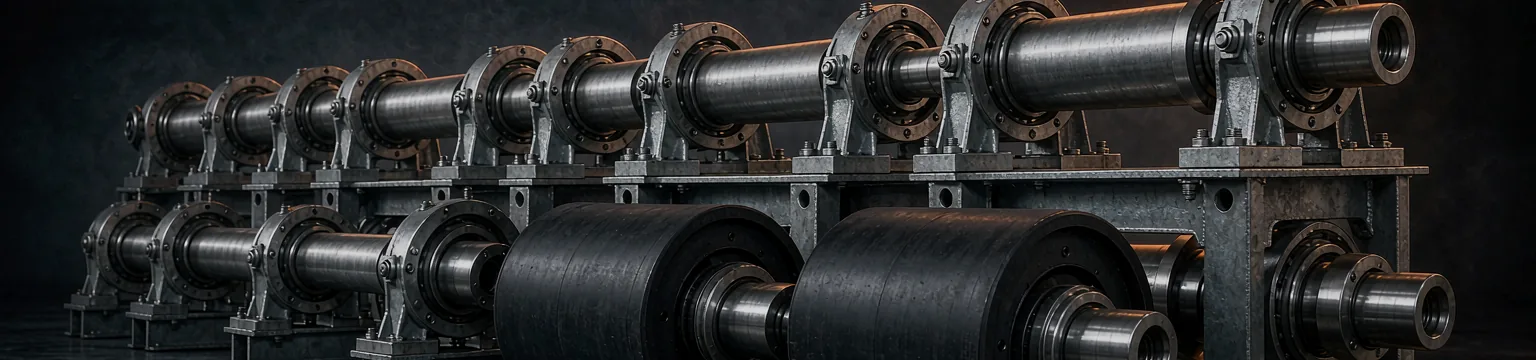
Wing Pulleys Self-Cleaning Where Material Builds Up
Wing pulleys with welded steel vanes that shed material instead of crushing it. Self-cleaning tail and bend pulleys to CEMA 501.1 envelope dimensions.
A wing pulley replaces the solid shell with a set of steel vanes welded to the end discs. Material that would otherwise be crushed between a drum and the belt falls through the gaps instead. On a tail pulley in a spillage zone, that is the difference between a pulley that runs for years and one that has to be cleaned every shutdown.
The trade is that a wing pulley does not support the belt across its full width. That is why it is used on the return end, at low tension, and almost never as a drive. The relevant standard is ANSI/CEMA 501.1, which covers envelope dimensions and load ratings for welded steel wing pulleys - and whose scope explicitly covers pulleys that do not transmit torque, not steel cord or other high-modulus belts.
What You Are Actually Getting
| Parameter | Specification |
|---|---|
| Construction | Welded steel vanes between end discs, forming an open cage |
| Standard | ANSI/CEMA 501.1 for envelope dimensions and load ratings. Note the scope: pulleys that do not transmit torque, and not written for steel cord or other high-modulus belts |
| Duty | Self-cleaning tail or bend pulley in a spillage zone. Not a drive pulley |
| Vane pattern | Straight or spiralled, set against the material and the belt speed |
| Shaft | 45# steel, equivalent to DIN C45 / JIS S45C / AISI 1045 |
| Balancing | Dynamic balancing to ISO 1940 grade G6.3 - the open cage is harder to balance than a drum, so this matters more, not less |
| Diameter | Set against the minimum bend diameter of the belt, same rule as a drum tail pulley |
| Belt support | Reduced by design - not for a belt that needs full-width support at that point |
When a Wing Pulley Beats a Drum
The decision is about what accumulates, not about cost. A wing pulley costs more than a plain drum of the same diameter, so it is specified for a reason.
| Situation | Drum | Wing | Why |
|---|---|---|---|
| Clean, dry loading point | Correct | Unnecessary | Nothing accumulates, so there is nothing to shed |
| Spillage collects at the tail | Build-up crushes and wears the belt | Material falls through the gaps | The open cage is the whole point |
| Sticky or wet material | Packs solid, belt rides high | Sheds, but gaps can bridge on very sticky clay | Wing better, but not a complete answer on clay |
| Steel cord belt | Correct | Risky - check the belt spec | CEMA 501.1 is not written for high-modulus belts |
| Drive position | Correct | Never | A wing pulley transmits no useful torque |
| Very high belt speed | Correct | Noise and turbulence | An open cage is louder and disturbs air at speed |
A guide to the trade-off. Wing pulleys solve an accumulation problem and create a belt-support and noise problem - they are not an upgrade across the board.
What to Check Before Ordering a Wing Pulley
Belt construction
CEMA 501.1 is scoped to pulleys that do not transmit torque, and it is not written for steel cord belts. If you run a steel cord belt, check the minimum bend diameter against the wing pulley you intend to fit before ordering.
Vane pattern
Straight vanes are simpler and stronger. Spiralled vanes shed material more continuously but are harder to build and to balance. For very sticky material, spiralled is worth the extra.
Balancing
An open welded cage is harder to balance than a solid shell. At speed an unbalanced wing pulley is a vibration source, which is why G6.3 balancing is not optional here.
Noise
The open cage generates more noise and more air disturbance than a drum. In an enclosed gallery or near a boundary this can be the deciding factor against it.
Replacement path
Wing pulleys are usually fitted to solve a problem that a plough or a cleaner would also solve. Check the cheaper fix first - a V-plough before the tail can remove the spillage before it ever reaches the pulley.
Where Wing Pulleys Earn Their Place
- Tail pulleys at transfer points — The classic application. Spillage that would be crushed by a drum falls through the cage instead.
- Bend pulleys in dusty returns — Where a bend pulley sits in a dirty part of the return run and collects material on the shell.
- Mobile and yard conveyors — Frequent changes of material and little maintenance opportunity. The self-cleaning property is worth more than the efficiency loss.
Wing Pulleys FAQ
Can a wing pulley be used as a drive pulley?
No. It transmits no useful torque - the belt only contacts the vane tips intermittently. A wing pulley belongs on a non-drive position, typically the tail.
Is a wing pulley the same as a spiral pulley?
No. A spiral or winged drum has vanes attached around a solid shell; a true wing pulley has an open cage with no shell at all. The distinction matters, because only the open cage lets material fall through.
What standard covers wing pulleys?
ANSI/CEMA 501.1, for envelope dimensions and load ratings of welded steel wing pulleys. Read its scope carefully - it covers pulleys that do not transmit torque and is not written for steel cord or other high-modulus belts.
Will a wing pulley damage my belt?
Not on a fabric belt at a normal tail position. On a high-modulus belt, or where the diameter is below the minimum bend, yes. That is a sizing question, so send the belt spec before ordering.
How Orders Run
T/T — 40% deposit with order, 60% balance before shipment. L/C at sight accepted for container orders.
Quoted per order. The schedule depends on the drawing, the quantity and the material — we state a firm date with the quotation instead of a catalogue figure.
15 months from B/L date against manufacturing defects. Claims supported by photos and batch number.
Packing, minimum order and Incoterms are set out in full on the quotation page.
Wing Pulleys Built to Your Drawing
Send the belt width, the duty and, if you have one, the drawing. We will specify it, quote within 24 hours, and ship samples in 2–3 days.
Talk to Our Engineers