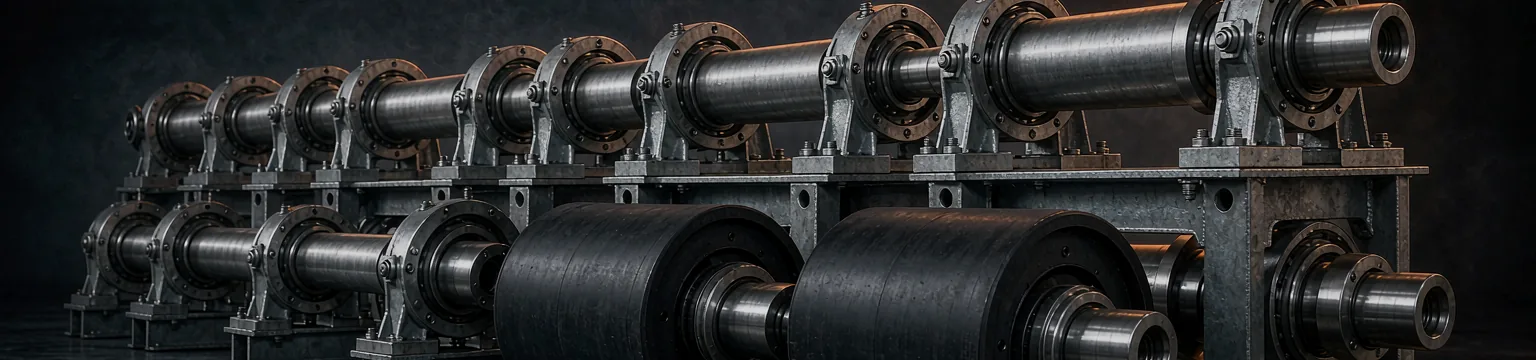
Tail Pulleys and Tail Drums At the Loading End of the Conveyor
Conveyor tail pulleys and tail drums at the loading end. CNC machined, ISO 1940 balanced, diameters from 250 mm. Built to your belt width and shaft drawing.
A tail pulley sits at the loading end and turns the belt back onto the carrying run. It carries far less torque than a drive pulley - often none at all - but it sits in the dirtiest part of the conveyor, directly where material drops and where spillage collects.
That is why the tail pulley choice is mostly about how it deals with material. A smooth-shell drum is the default. A wing pulley lets spillage fall through the gaps instead of being crushed between the shell and the belt, which is the standard fix for a tail that keeps building up.
What You Are Actually Getting
| Parameter | Specification |
|---|---|
| Machining | CNC lathes to ±0.01 mm on shell and shaft; bore finished after welding so it cannot go oval |
| Welding | Displacement-robot beam welding for uniform seam strength |
| Balancing | Dynamic balancing to ISO 1940 grade G6.3 |
| Shell | Carbon steel; stainless shell available for wash-down duty |
| Shaft | 45# steel, equivalent to DIN C45 / JIS S45C / AISI 1045 |
| Configuration | Smooth drum, wing pulley, or lagged where the tail also drives or takes high tension |
| Sizing rule | The tail diameter must let the belt bend without over-stressing the carcass at the lowest tension point on the conveyor |
| Standards | GB / DIN / JIS / BS dimensions built directly from your drawing |
Tail and Bend Pulley Diameter by Belt Width
Tail pulleys are normally smaller than the drive pulley at the same belt width, because the belt tension there is lowest. This is the standard range.
| Belt width (mm) | Standard tail / bend diameter (mm) |
|---|---|
| 500 | 250 - 500 |
| 650 | 250 - 630 |
| 800 | 250 - 1000 |
| 1000 | 250 - 1600 |
| 1200 | 250 - 1600 |
| 1400 | 315 - 1600 |
| 1600 | 400 - 1600 |
| 1800 | 400 - 1600 |
| 2000 | 500 - 1600 |
| 2200 | 630 - 1600 |
| 2400 | 800 - 1600 |
The wide diameter range at each belt width is deliberate - the tail diameter is set by belt construction and the tension at that point, not by belt width alone.
Why Tail Pulleys Fail, and What to Do About It
Bearing housing bore worn oval
Usually unbalance, or a bore machined before welding. We finish the bore after welding and balance to G6.3 - both are process decisions, not inspection catches.
Material packed between shell and belt
Spillage at the loading point gets carried around the tail and crushed. A wing pulley lets it fall through. A plough on the return strand before the tail is the other half of the fix.
Belt wandering at the tail
Almost always the pulley is not square to the belt line, or the structure has settled. Check square before changing the pulley - a new pulley in an out-of-square frame will walk the belt just the same.
Crack around the end disc weld
The pulley was undersized for the actual belt tension. Recalculate the diameter and the disc thickness from the real T1, not from the original design case.
Smooth or wing
Smooth where the material is dry and the loading point is clean. Wing where spillage is a fact of life - but note that a wing pulley is not for a belt that has to be supported across its full width at that point.
Tail Pulley Position Decides the Duty
- Fixed take-up at the tail — The tail pulley also carries the take-up, so it moves. The shaft and bearing arrangement has to allow for that travel - send the take-up drawing.
- Screw take-up — Common on shorter conveyors. The pulley is fixed in a sliding frame, and the frame squareness matters as much as the pulley itself.
- Gravity take-up tower — The tail is fixed and the take-up is elsewhere. Simpler pulley, but the belt tension at the tail is set by the tower, so tell us where the take-up actually is.
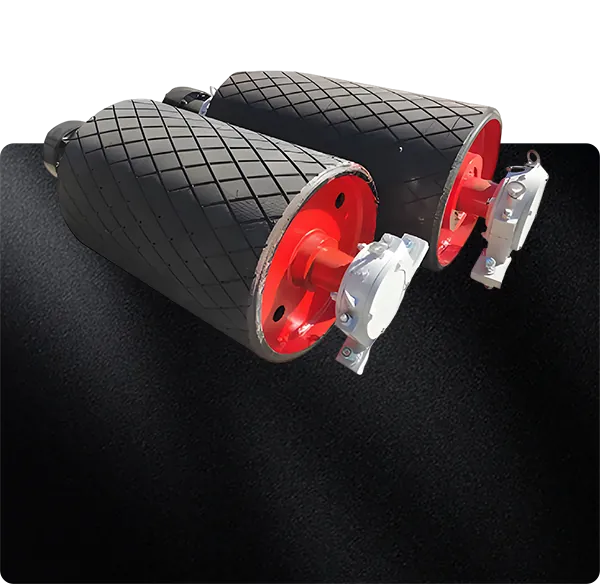
Tail Pulleys and Tail Drums FAQ
Tail pulley or tail drum - any difference?
No. Tail pulley, tail drum, tail roller and return drum are used interchangeably. The trade tends to say drum for a plain cylindrical shell and pulley for anything with a shaft and bearing assembly, but suppliers mix them freely.
Should I use a wing pulley at the tail?
Where spillage collects and gets crushed between shell and belt, yes. It is a self-cleaning solution, not a traction solution - a wing pulley transmits no useful torque and should not be used as a drive.
How much smaller can the tail be than the drive?
It depends on the belt construction more than on belt width. A fabric belt will accept a much tighter bend than a steel cord belt. Send the belt spec and we will confirm the minimum diameter rather than let you specify one that damages the carcass.
Can you build to my existing shaft drawing?
Yes, and that is the normal route for a replacement. Send the drawing or the worn pulley - shaft ends, bearing centres and face width matter more than the shell diameter.
How Orders Run
T/T — 40% deposit with order, 60% balance before shipment. L/C at sight accepted for container orders.
Quoted per order. The schedule depends on the drawing, the quantity and the material — we state a firm date with the quotation instead of a catalogue figure.
15 months from B/L date against manufacturing defects. Claims supported by photos and batch number.
Packing, minimum order and Incoterms are set out in full on the quotation page.
Tail Pulleys and Tail Drums Built to Your Drawing
Send the belt width, the duty and, if you have one, the drawing. We will specify it, quote within 24 hours, and ship samples in 2–3 days.
Talk to Our Engineers