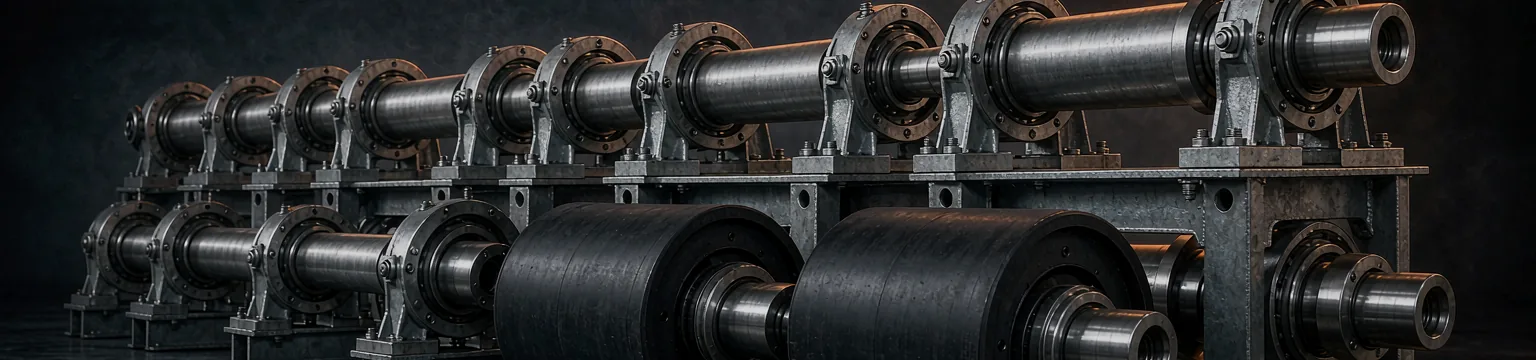
Conveyor Drive Pulleys Head Pulley, Lagged to Your Traction Requirement
Conveyor drive pulleys and head pulleys, lagged in rubber, ceramic or diamond groove. CNC machined shell, ISO 1940 balanced, diameters matched to belt width.
A drive pulley, usually the head pulley as well, is the one component on the conveyor that has to transmit torque as well as support the belt. That single fact decides how it is built: a thicker shell to take the torque, a shaft sized for combined bending and torsion, and a lagging surface chosen so the belt does not slip under the tension the drive is applying.
Everything else on a drive pulley follows from the duty. Diameter is set so the belt can accept the bend without over-stressing the carcass. Face width follows the belt width. Lagging follows the wetness, the tension and how much of the wrap angle the drive has to work with.
What You Are Actually Getting
| Parameter | Specification |
|---|---|
| Machining | CNC lathes to ±0.01 mm on shell and shaft |
| Welding | Displacement-robot beam welding for uniform seam strength |
| Balancing | Dynamic balancing to ISO 1940 vibration limits, grade G6.3 - above roughly 60 rpm unbalance is what destroys bearing housings |
| Shell | Carbon steel; stainless shell available for wash-down duty |
| Shaft | 45# steel, equivalent to DIN C45 / JIS S45C / AISI 1045 |
| Shaft sizing | CEMA method - maximum bending moment at the hub centreline, maximum torque at the shaft periphery, deflection held near 0.0013 radians at the bearing centreline |
| Lagging | Rubber, ceramic, diamond groove, or vulcanised with grooving. Bonding method stated on the order - cold bond is not equivalent to hot vulcanised |
| Standards | GB / DIN / JIS / BS. Name the edition on the PO, because requirements are confirmed per project |
Drive Pulley Diameter by Belt Width
The diameter has to be large enough that the belt can bend around it without over-stressing the carcass, and large enough to give the wrap angle the drive needs. This is the standard range.
| Belt width (mm) | Standard drive diameter (mm) |
|---|---|
| 500 | 500 |
| 650 | 500 - 630 |
| 800 | 630 - 1000 |
| 1000 | 800 - 1150 |
| 1200 | 800 - 1150 |
| 1400 | 1000 - 1350 |
| 1600 | 1150 - 1600 |
| 1800 | 1150 - 1800 |
| 2000 | 1350 - 2000 |
| 2200 | 1600 - 2200 |
| 2400 | 1800 - 2400 |
Standard range only. A steel cord belt needs a larger diameter for the same belt width, because the cord cannot accept as tight a bend as a fabric carcass.
Lagging: The Part That Decides Whether the Belt Slips
Plain rubber, 10 - 15 mm
About 0.35 friction coefficient. Correct on dry, clean, general bulk handling. Loses grip quickly once wet or muddy - this is the most common cause of a drive that slips only in the rainy season.
Diamond groove rubber
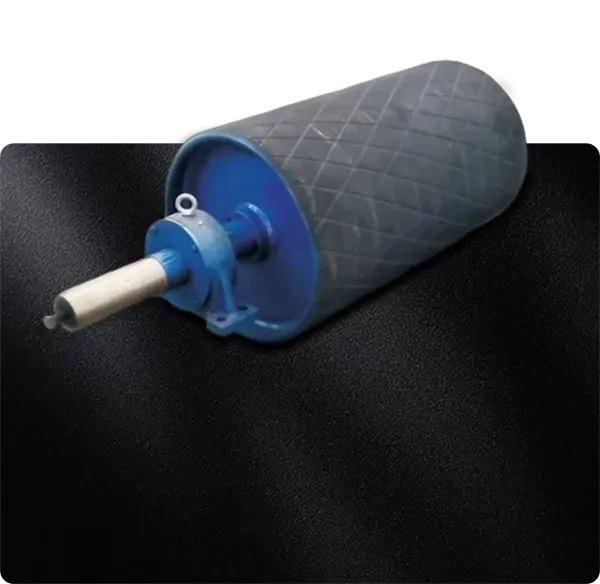
About 0.40. Channels water and fines out from under the belt. The default choice for wet, dusty or outdoor conveyors.
Herringbone groove
About 0.40, and it sheds water in both directions, so it is the right pattern on a reversing belt. More expensive to re-lag.
Ceramic tile in rubber
About 0.50. Ceramic bites through a water or mud film where rubber slips. Used on high-torque drives in mining and ports. Aggressive on thin belt covers, so check the cover grade.
Polyurethane
About 0.40 with a lower temperature ceiling than rubber. Chosen for food, grain and hygiene-sensitive plants rather than for grip.
Two Failure Modes Worth Designing Out
- Shaft broken at the keyway — Fatigue from a sharp keyway corner plus a reversing load. Specify a shrink disc, or a larger shaft with a radiused keyway - this is a design decision at order, not a maintenance fix.
- Lagging thrown off — Wrong vulcanising temperature or poor surface preparation at the re-lag. Demand the bonding method in writing before the work starts.
Conveyor Drive Pulleys FAQ
Is the drive pulley always the head pulley?
Usually, but not always - a drive can be fitted at the tail or at a bend, and some conveyors have two drive pulleys. Tell us which position it goes in, because the wrap angle and the shaft loading both change.
How do I choose the lagging?
From the environment and the tension. Dry and clean, plain rubber. Wet or dusty, diamond groove. Reversing, herringbone. High torque and wet, ceramic. Food or hygiene, polyurethane.
What diameter do I need?
It follows the belt width and, more strictly, the belt construction. A steel cord belt needs a larger diameter than a fabric belt of the same width. Send the belt spec and the belt tension and the diameter can be calculated rather than guessed.
Do you balance the pulley?
Yes, dynamically to ISO 1940 grade G6.3. Above roughly 60 rpm an unbalanced pulley destroys bearing housings, and you hear it across the plant before you can measure it.
How Orders Run
T/T — 40% deposit with order, 60% balance before shipment. L/C at sight accepted for container orders.
Quoted per order. The schedule depends on the drawing, the quantity and the material — we state a firm date with the quotation instead of a catalogue figure.
15 months from B/L date against manufacturing defects. Claims supported by photos and batch number.
Packing, minimum order and Incoterms are set out in full on the quotation page.
Conveyor Drive Pulleys Built to Your Drawing
Send the belt width, the duty and, if you have one, the drawing. We will specify it, quote within 24 hours, and ship samples in 2–3 days.
Talk to Our Engineers