Lagging: Rubber, Ceramic or Diamond Groove The Surface That Decides Whether the Belt Slips
Pulley lagging in plain rubber, diamond groove, herringbone, ceramic tile and polyurethane. Grip coefficients compared, bonding method stated in writing.
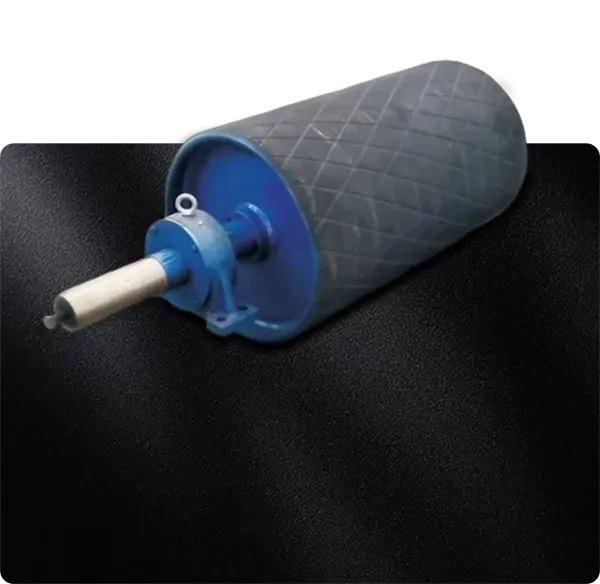
Lagging is the rubber or ceramic layer on a drive pulley that creates friction between the pulley and the belt. Without adequate lagging the drive cannot transmit its torque, and the belt slips - usually only under peak load, which is exactly when it matters.
The friction coefficient is the number that decides the drive, but it is not the only number that matters. Bonding method decides whether the lagging stays on, and pattern decides whether the groove sheds water or fills with clay instead.
What You Are Actually Getting
| Parameter | Specification |
|---|---|
| Lagging types | Plain rubber, diamond groove, herringbone groove, ceramic tile in rubber, polyurethane |
| Thickness | 10 - 15 mm plain rubber |
| Bonding | Hot vulcanised. Cold bond is not equivalent - state the method on the order and demand it in writing |
| Ceramic | Ceramic tiles embedded in rubber, for high torque, wet or slurry duty |
| Grooving | Diamond for water shedding, herringbone for reversing belts |
| Application | After machining and balancing, so the balance is not disturbed by the lagging |
Lagging Grip Comparison
Friction coefficient is measured on the pulley surface and quoted as a working figure. The real question is what happens once it is wet, muddy or oily - that is where the difference between the options shows up.
| Lagging | Grip (mu) | Best for | Watch out for |
|---|---|---|---|
| Plain rubber, 10 - 15 mm | approx. 0.35 | Dry, clean, general bulk handling | Loses grip quickly once wet or muddy |
| Diamond groove rubber | approx. 0.40 | Wet, dusty, outdoor conveyors - the default choice | Grooves fill with sticky clay and need cleaning |
| Herringbone groove | approx. 0.40 | Reversible belts - sheds water in both directions | More expensive to re-lag |
| Ceramic tile in rubber | approx. 0.50 | High torque, wet, slurry, steep incline | Aggressive on thin belt covers - check the cover grade |
| Polyurethane | approx. 0.40 | Food, grain and hygiene-sensitive plants | Lower temperature ceiling than rubber |
Working figures for comparison, not guaranteed values for your installation. Real traction depends on belt tension, wrap angle and belt cover condition as well.
What Decides Whether Lagging Lasts
Bonding method before pattern
Most lagging failures are debonding, not wear. Vulcanising temperature and surface preparation decide it, and a cold-bonded lagging is not equivalent to a hot vulcanised one whatever the pattern.
Not all ceramic is the same
Ceramic tiles bite through water and mud where rubber slips, which is why high-torque wet drives use them. But aggressive tile on a thin belt cover will wear the cover instead of the lagging.
Groove pattern follows the belt
Diamond sheds water in one direction of travel. A reversing belt needs herringbone, or it will pump water under the belt on the reverse run.
Lagging after balancing
Lagging is applied after machining and balancing. If the sequence is reversed the balance is gone, which is one of the ways a re-lagged pulley develops a vibration it did not have before.
Ceramic tile covers a worn rubber surface
Do not lag over a worn or pitted shell. Re-lagging onto a damaged surface is how a new lagging fails within months.
Choosing by Installation
- Outdoor, wet, dusty — Diamond groove rubber. This is the default for most yard, port and quarry conveyors.
- High-torque drive, wet or slurry — Ceramic tile in rubber, with the belt cover grade checked at the same time.
- Reversing conveyor — Herringbone. A diamond pattern pumps water the wrong way on the reverse run.
- Food, grain, hygiene plants — Polyurethane, accepting the lower temperature ceiling.
Lagging: Rubber, Ceramic or Diamond Groove FAQ
What friction coefficient does my drive need?
It depends on the belt tension, the wrap angle and the torque. The lagging table gives working values to compare options; it does not replace the drive calculation. Send the belt tension and the wrap angle and we will tell you which option closes the gap.
Cold bond or hot vulcanised?
Hot vulcanised for anything that has to last. Cold bond is a field repair and depends heavily on cleanliness and cure time. If the pulley is being re-lagged properly, specify hot.
Can I add lagging to an existing pulley?
Yes, if the shell is sound. The shell is inspected and machined first, then lagged and balanced. Lagging over a worn or pitted shell is a short-lived repair.
Ceramic or diamond groove?
Ceramic where the torque is high and the surface is wet or muddy - it bites through a water film. Diamond where the duty is wet but moderate. Ceramic costs more and wears belt covers faster.
How Orders Run
T/T — 40% deposit with order, 60% balance before shipment. L/C at sight accepted for container orders.
Quoted per order. The schedule depends on the drawing, the quantity and the material — we state a firm date with the quotation instead of a catalogue figure.
15 months from B/L date against manufacturing defects. Claims supported by photos and batch number.
Packing, minimum order and Incoterms are set out in full on the quotation page.
Lagging: Rubber, Ceramic or Diamond Groove Built to Your Drawing
Send the belt width, the duty and, if you have one, the drawing. We will specify it, quote within 24 hours, and ship samples in 2–3 days.
Talk to Our Engineers