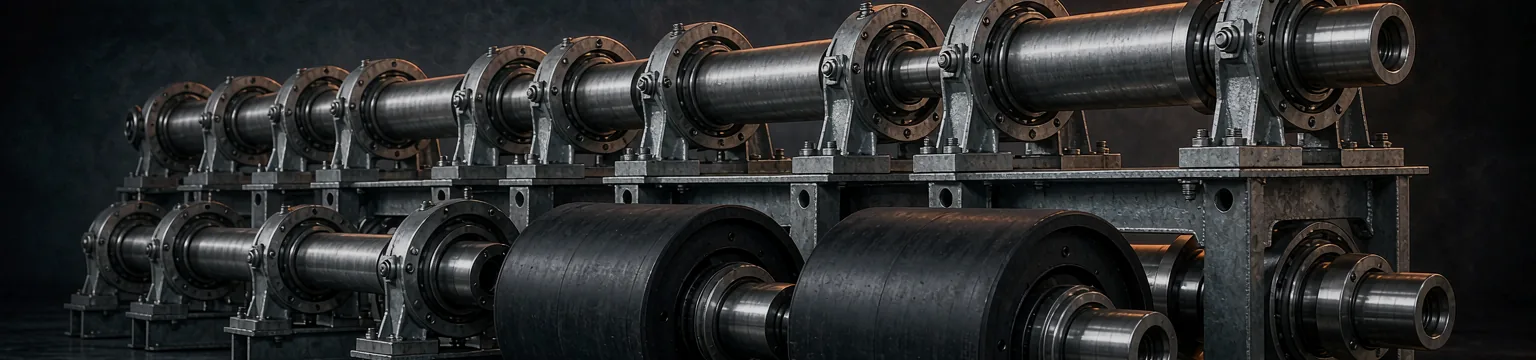
Buying Conveyor Rollers from China: The 11-Point Inspection Checklist
The savings are real; the risk is in what was never written down. Eleven checkpoints covering wall thickness, bearings, seals, runout, coating and packing.
Key Takeaways
- The savings are real; the risk is in what is not written down. Price differences between Chinese suppliers usually trace back to wall thickness, bearing brand and seal construction.
- Eleven checkpoints cover almost every failure we see in imported rollers. Most can be verified before the container is loaded.
- Order a sample. Then inspect the mass order against it. A sample without an agreed inspection standard protects nobody.
- Ask for the load rating and wall thickness in the quotation. A supplier who will not state them is quoting a different product to the one you think you are buying.
- Packing decides the arrival condition. Rollers are heavy and awkward; poor packing damages more units than poor manufacturing.
Why Imported Rollers Sometimes Disappoint
Conveyor rollers are simple products, and China has factories that build them extremely well. It also has traders who will source from whichever workshop is cheapest that month. The failure pattern in imported rollers is remarkably consistent, and it is almost always a specification gap rather than a manufacturing mystery: the buyer asked for a size, and got a size.
The purpose of this checklist is to close that gap before the order is placed, not after the first failures.
The Eleven-Point Inspection Checklist
| # | Check | How to verify | What goes wrong if skipped |
|---|---|---|---|
| 1 | Tube wall thickness | State it in millimetres on the PO; verify with a caliper or ultrasonic gauge on arrival | Shell wears through early; the single most common downgrade |
| 2 | Tube material | Ask for the grade and, for a large order, a mill certificate | Substandard steel welds and machines less predictably |
| 3 | Shaft material and diameter | Named grade on the PO (45# / C45 / S45C / 1045); measure the machined end | Shaft bends or the keyway fails under load |
| 4 | Bearing designation and brand | Brand named on the PO and on the packing; ask for bearing photos before shipment | Unbranded bearings are where the price difference usually lives |
| 5 | Bearing clearance class | C3 as standard, C4 for high temperature — written down | Wrong clearance causes seizure at temperature or noisy running |
| 6 | Seal construction | Describe the stack: grease inner seal, multi-stage labyrinth, retention cap. Ask for a sectional photo. | Dust ingress is the biggest single cause of early failure in the field |
| 7 | Weld quality | Visual on the end disc weld; ask whether shielded arc welding is used | Porosity leads to cracks and end-cap failure |
| 8 | Runout | Ask for the TIR limit (e.g. 0.5 mm) and a check in the pre-shipment inspection | Belt noise, vibration, and premature bearing wear |
| 9 | Grease type and fill | Temperature range stated numerically; fill by weight | Under-filled rollers run hot; over-filled rollers churn and leak |
| 10 | Coating or galvanizing | Paint system and dry film thickness, or galvanizing standard | Corrosion in port and coastal duty within a year |
| 11 | Packing and marking | Ask for the packing drawing before shipment; check a loading photo | Deformed shells and damaged shaft ends on arrival |
Where the Price Difference Actually Comes From
When two quotations for the same nominal roller differ by 30 %, the gap is usually in these four places — in this order.
| Item | Cheaper choice | Consequence |
|---|---|---|
| Tube wall | 3 mm instead of 5 mm | Wears through in abrasive duty; weighs less, so it is easy to miss on receipt |
| Bearing | Unbranded instead of a named brand | Life can be a fraction of the rated figure; failure is sudden, not gradual |
| Seal | Single lip instead of multi-stage labyrinth | Fine indoors, fails fast in dust, wash-down or salt air |
| Coating | Standard paint instead of galvanizing | Corrosion within a year in port or coastal environments |
None of these is visible in a product photograph. All of them are visible in a specification, which is why the specification does more work than the inspection.
Sample Orders: What a Sample Can and Cannot Prove
A sample proves the build quality of one unit and the factory's capability. It does not prove that the mass order will match, because the sample was probably hand-assembled and inspected more carefully than the production run.
To make the sample useful, agree in writing that the mass order will be inspected against it:
- Keep the sample sealed and labelled as the reference unit.
- Write down the measurements you checked on it: wall thickness at three points, shaft diameter, runout, weight.
- Ask for the pre-shipment inspection to record the same measurements on a sample from the production lot.
- Agree what happens if the numbers differ — that conversation is much easier before the order than after.
Pre-Shipment Inspection: The Minimum Set
If you are not using a third-party inspection service, ask the supplier for these as a photo and video record before the container is sealed. It takes them under an hour and it prevents most disputes.
- Wall thickness measurement on three randomly selected rollers, caliper or gauge visible in shot.
- Shaft diameter and shaft-end type photographed next to a caliper reading.
- Free-rotation check on several units, filmed.
- Bearing brand visible on the bearing or the packaging.
- Coating thickness reading, or a galvanizing certificate.
- ID tag or marking on each unit, if traceability was specified.
- Packing photos: how the rollers are supported, how the shaft ends are protected, how the container is braced.
Packing and Shipping: The Underrated Half
Rollers are long, heavy and easy to dent. A well-made roller with a bent shaft end is scrap on arrival. Specify:
- Shaft ends protected — caps, sleeves or foam, not just wrapping.
- Supported along the shell in the crate, so the roller is not carried on its shaft ends.
- Container bracing — timber dunnage that stops the load shifting in transit.
- Marking — item numbers matching the packing list, so one missing size is identifiable without unpacking everything.
Mixed containers with idlers, pulleys, frames and belt cleaners are normal, and a supplier who ships them regularly will have a standard packing scheme. Ask to see it.
Working With a Factory Rather Than a Trader
Both can serve you well, and the distinction matters less than whether the specification is honoured. What a factory offers is the ability to change something — a non-standard face length, a different wall, a different seal — and to tell you what that does to the price and the lead time.
A trader is often better at consolidation and small mixed orders. If you need twenty different sizes in one container, that is a real service. If you need 5,000 identical rollers to a tight specification, a factory is the better conversation.
FAQ
How do I verify bearing brand before shipment?
Ask for photographs of the bearing and its packaging at assembly, and specify that the brand is written on the purchase order with no substitution. For a large order, a third-party inspector can check a sample of assembled units.
Is a third-party inspection worth the cost?
On a first order, or on any order where the rollers are going somewhere expensive to reach, yes. On repeat orders from a supplier with a proven record, the pre-shipment photo record is usually enough.
What is a reasonable lead time?
Standard rollers 15–30 days after drawing approval, plus 3–5 days if galvanizing is specified, plus transit. A quotation promising a week on a large order is worth questioning rather than celebrating.
Should I buy idlers and frames from the same supplier?
Yes if you can. The roller face length only works with a matching frame series, and mixing them across suppliers is where fitting problems appear. See brackets and frames.
How do I handle a quality dispute after arrival?
It is far easier if the specification was written down, the sample was retained, and the pre-shipment measurements exist. Photograph the non-conforming units against the caliper reading and reference the PO line. Disputes that drag on are almost always disputes about what was agreed, not about what arrived.
Send Us Your Duty — We Will Return a Build
Belt width, speed, material, tonnage, temperature and environment. We come back with the build, drawings and a quotation.
Related Guides
Why Your Conveyor Belt Runs Off Centre: 9 Causes, in the Order to Check Them
A belt does not wander; it is steered. Find the cause in the right order — build-up, loading point, structure, pulleys, idlers, camber, splice, tension — before touching an idler.
How to Measure a Conveyor Roller for Replacement — Without the Drawing
The drawing is gone and the line is down. Six measurements and one photo define a roller completely — here is how to take them and what to send with the enquiry.
Rubber, Diamond or Ceramic: Choosing Conveyor Pulley Lagging
Lagging sets the friction that decides how much tension the drive can transmit. Rubber, diamond groove or ceramic — and why the bonding method matters more than the material.
Where to Go Next
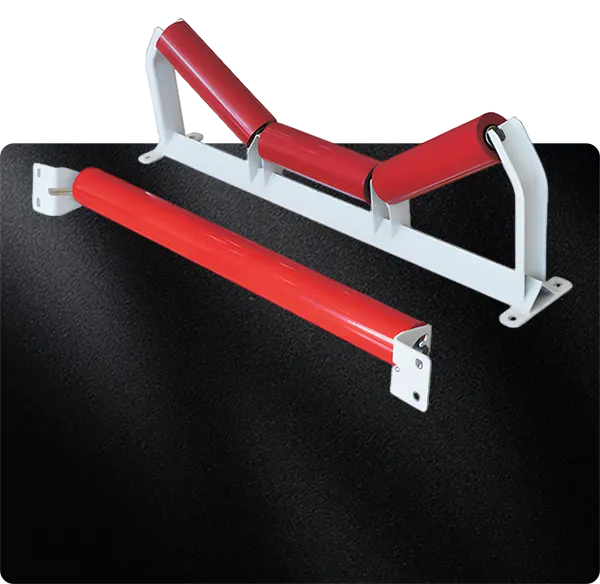
Troughing Idler
Carrying-side support, 20°/35°/45° trough angles.
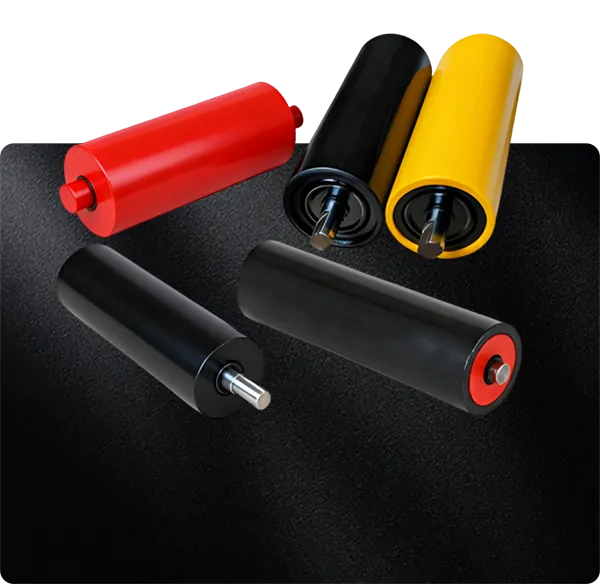
Carrying / Return Idler
Flat carry and return duty, standard and heavy-wall tube.
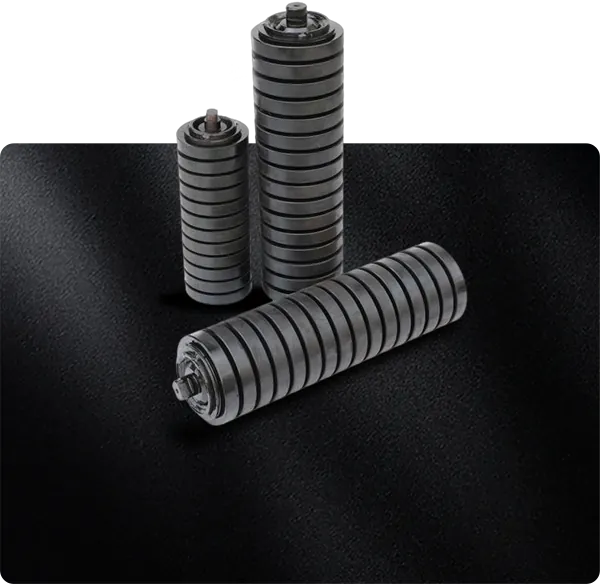
Impact Roller
Rubber-ring cushioning at the loading point.
Conveyor Pulleys
Drive, bend, tail & snub pulleys — with rubber, ceramic or herringbone lagging to your spec.
Conveyor Belts
EP/NN, steel cord, heat, oil and abrasion resistant covers. 17 types for different duties.
Cleaners & Impact Beds
Belt cleaners, impact beds, skirt seals — the parts that decide whether your idlers survive.