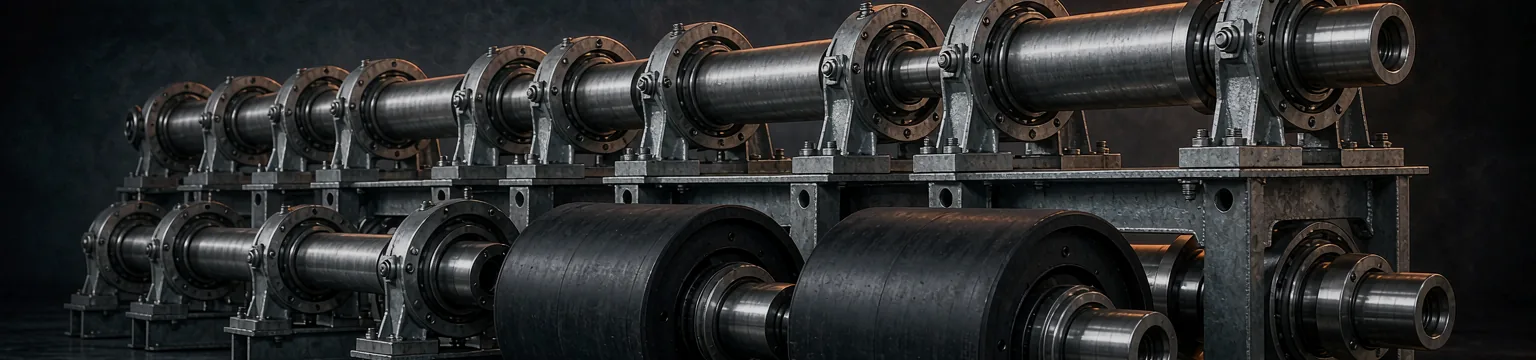
How to Measure a Conveyor Roller for Replacement — Without the Drawing
The drawing is gone and the line is down. Six measurements and one photo define a roller completely — here is how to take them and what to send with the enquiry.
Key Takeaways
- Six measurements replace the drawing. Face length, shell diameter, shaft diameter, shaft-end type, shaft-end length, total shaft length — those six fully describe a roller.
- Measure the face length, not the roller length including shaft ends. Confusing the two is the most common ordering error we see.
- Measure a worn roller in the unworn band, or the diameter you send will be too small and the roller will sit low.
- Photo plus tape measure is acceptable — a picture with the tape visible is often faster and clearer than four emails.
- Wall thickness cannot be measured from outside. Say so on the enquiry instead of guessing, and we will specify it from the duty.
The Situation: The Drawing Is Gone
A roller has seized, the line is down or running at reduced rate, and the plant drawing for that conveyor was lost in an archive move, or was never handed over by the original installer. The instinct is to send a photo to a supplier and ask for "the same one".
That works eventually, but it costs two or three rounds of questions and often one wrong shipment. Six measurements and one clear photo gets it right first time.
The Six Measurements That Define a Roller
| # | Measurement | How to take it | Why it matters |
|---|---|---|---|
| 1 | Face length (shell length) | From one end of the steel tube to the other, excluding the shaft | Decides whether the roller fits between the frame brackets |
| 2 | Shell diameter | Outside diameter of the tube, measured with a caliper, in an unworn band | Sets the belt height and the load rating |
| 3 | Shaft diameter | Across the machined shaft end, not the painted surface | Must match the bracket slot or the bearing housing |
| 4 | Shaft-end type | Look at the end: flat, drilled, threaded, with a groove, or with a pressed end cap | The single most common mismatch — see the table below |
| 5 | Shaft-end length | From the end cap face to the very end of the shaft, each side | Fixes how far the roller sits in the bracket |
| 6 | Total shaft length | End to end, through the roller | Confirms measurements 1 and 5 add up |
A useful check: total shaft length should equal face length plus both shaft-end lengths, allowing for any shaft recessed inside the roller. If your numbers do not add up, the roller has a recessed shaft and you need to say so.
Shaft-End Types You Will Meet
| Type | Appearance | Where it is used |
|---|---|---|
| Flat ended | Plain machined cylinder | Slides into a bracket slot; retained by a pin or clip |
| Flatted (two flats) | Two parallel milled faces near the end | Prevents rotation in the bracket; common on carrying idlers |
| Threaded | Male thread, sometimes with a nut and washer | Bolted through the frame; common on return rollers |
| Grooved | Circular groove near the end | Takes a retaining ring or a spring clip |
| D-end / drilled | Cross hole through the shaft end | Takes a split pin; found on heavier frames and garland systems |
| With pressed end cap | Steel cap covering the bearing, shaft protruding | Dusty duty; the cap is part of the seal, not cosmetic |
If the shaft end is damaged or worn oval, say so. Supplying a new roller to a worn shaft-end dimension reproduces the wear pattern, and the new roller will be loose in the bracket from day one.
Measuring Without Taking the Conveyor Apart
You can usually get everything you need with the belt still on, if you can rotate a roller out of its bracket slot:
- Face length — measure between the frame brackets and subtract the two shaft-end lengths, or measure a removed neighbour.
- Shell diameter — caliper across the top of the shell, in a band the belt does not touch, or on the underside where wear is lightest.
- Shaft diameter and end type — these need the roller out, or a photo with the end clearly visible.
The practical answer is to remove one roller. It takes minutes on most frames and turns a week of guesswork into one email.
The Mistakes That Cause a Wrong Shipment
| Mistake | Result | Do this instead |
|---|---|---|
| Measuring total length including shaft and calling it face length | Roller is 100–200 mm too long and will not fit | Measure the tube only |
| Measuring the shell over thick paint or a rubber sleeve | Diameter too large; belt sits high | Measure bare steel, and note if the shell is sleeved |
| Measuring a worn shell at its thinnest point | Diameter too small; belt sits low and tracking suffers | Measure an unworn band, or the end cap diameter |
| Assuming wall thickness from the outside | You get a 3 mm wall when the duty needs 5 mm | State the duty and let the supplier specify the wall — or cut a scrap roller and measure |
| Quoting "108 mm idler, standard" | "Standard" means something different at every supplier | Quote the six measurements plus the duty |
What Else to Send With the Measurements
- Belt width and trough angle — needed for carrying rollers, because the three rollers of a set have different lengths.
- Position on the conveyor — carrying, return, impact or training. Return rollers are often a different length from the carrying roller in the same frame.
- Material and environment — abrasive ore, hot clinker, salt spray or wash-down. This is what decides the wall thickness, the seal and the coating.
- Quantity — trial quantity and expected annual quantity. Annual volume changes what we can offer on price.
- One photo of the frame with a tape measure across it — the fastest way to catch a mismatch before it ships.
When the Roller Is Non-Standard
Roughly one replacement in five that we quote is not a catalogue size: a face length that does not match the frame series, a shaft end from an older standard, or a frame that has been modified on site. None of that is a problem — we build to drawing with no tooling charge on a first order — but it does mean the measurements have to be right, because there is no standard part to fall back on.
If you have the original drawing in any format — PDF, a scan, even a photo of a paper drawing — send it. A drawing plus one confirmation photo is the most reliable enquiry we receive.
FAQ
Can you identify a roller from a photo alone?
Usually yes, for the shaft-end type and the general build, but not the face length or the diameter to the millimetre. A photo plus the belt width will normally get us to a quotation with one clarifying question rather than four.
How do I measure wall thickness without cutting the roller?
You cannot measure it reliably from outside. An ultrasonic thickness gauge works on a clean, unpainted shell if you have one. Otherwise state the duty — abrasive material, belt speed and load — and the wall is specified from that rather than guessed from the old part.
My old roller has no shaft at all, just pressed ends. What then?
That is a sealed-for-life design where the end cap carries the bracket interface. Measure the end cap diameter, the cap length and the overall length between brackets, and note that the shaft ends are pressed caps. We build these regularly.
Do I need to replace all the rollers in a set?
If one of the three has seized, replace all three. The other two have done the same hours and are carrying a higher share of the load while the failed one drags. Replacing one at a time means coming back twice.
What is the fastest way to get a replacement?
Send the six measurements, the belt width, the position on the conveyor and one photo, in a single message. Orders that arrive complete are quoted the same or next working day; orders that arrive as a photo and "same as this please" take two or three exchanges.
Send Us Your Duty — We Will Return a Build
Belt width, speed, material, tonnage, temperature and environment. We come back with the build, drawings and a quotation.
Related Guides
Why Your Conveyor Belt Runs Off Centre: 9 Causes, in the Order to Check Them
A belt does not wander; it is steered. Find the cause in the right order — build-up, loading point, structure, pulleys, idlers, camber, splice, tension — before touching an idler.
Rubber, Diamond or Ceramic: Choosing Conveyor Pulley Lagging
Lagging sets the friction that decides how much tension the drive can transmit. Rubber, diamond groove or ceramic — and why the bonding method matters more than the material.
CEMA, DIN and GB/T Idler Standards Compared — What Actually Differs
A CEMA C idler and a GB/T idler are not the same claim. Life classes, dimensional tolerances and the specification lines that make supplier quotes comparable.
Where to Go Next
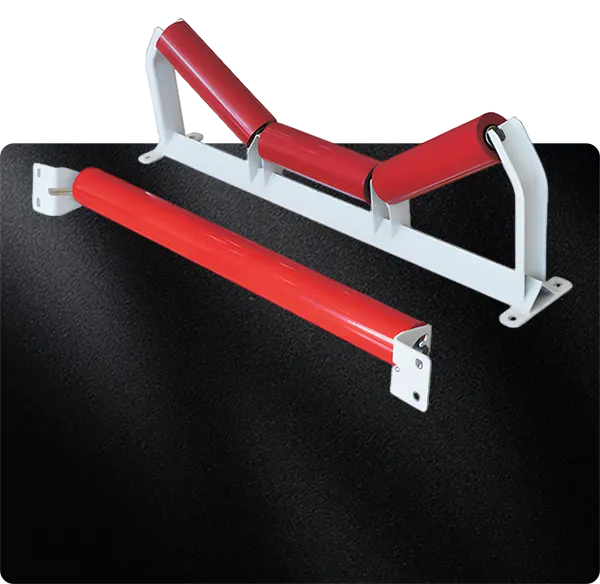
Troughing Idler
Carrying-side support, 20°/35°/45° trough angles.
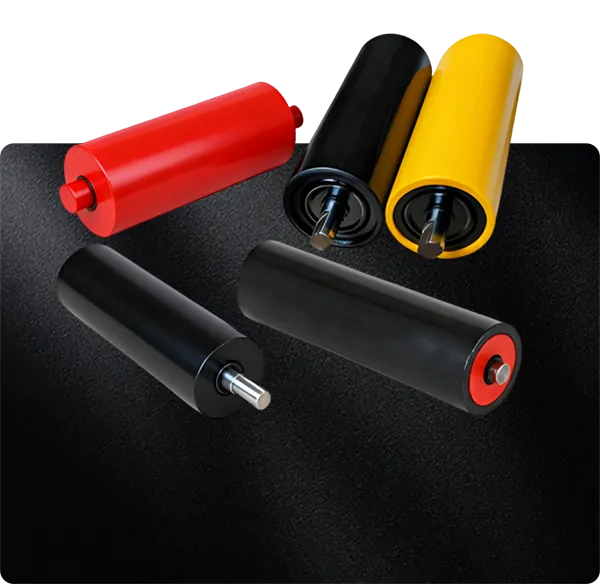
Carrying / Return Idler
Flat carry and return duty, standard and heavy-wall tube.
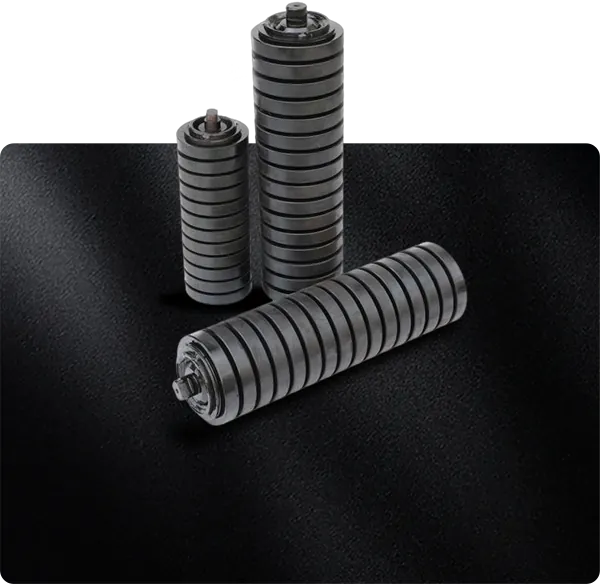
Impact Roller
Rubber-ring cushioning at the loading point.
Conveyor Pulleys
Drive, bend, tail & snub pulleys — with rubber, ceramic or herringbone lagging to your spec.
Conveyor Belts
EP/NN, steel cord, heat, oil and abrasion resistant covers. 17 types for different duties.
Cleaners & Impact Beds
Belt cleaners, impact beds, skirt seals — the parts that decide whether your idlers survive.