CEMA, DIN and GB/T Idler Standards Compared — What Actually Differs
A CEMA C idler and a GB/T idler are not the same claim. Life classes, dimensional tolerances and the specification lines that make supplier quotes comparable.
Key Takeaways
- Three standards families dominate idler procurement: CEMA in North America and much of the export market, DIN in Europe, GB/T in China. They are not interchangeable.
- "CEMA C" is a life class, not a quality adjective. It is a bearing load-rating basis. A quotation that says "CEMA standard" without naming the class has told you nothing.
- The most valuable thing you can do is write the standard, the class and the wall thickness into the enquiry — that makes quotes comparable.
- Dimensions are usually compatible even when life classes are not. Which means a roller can fit perfectly and still fail in a year.
- Ask for the load rating and the life basis on paper. The supplier who cannot state both has not calculated anything.
Why the Standard Matters More Than the Catalogue Photo
Two idlers can look identical, weigh the same and fit the same frame while being designed to completely different life expectations. The difference is in the bearing selection, the seal arrangement, the tube wall and the load rating basis — none of which is visible from outside.
When a buyer compares three quotations on price alone, they are usually comparing three different products. The standards exist to make that comparison honest, but only if the standard is named in the enquiry.
The Three Families
| Family | Where it dominates | What it governs | Characteristic |
|---|---|---|---|
| CEMA (Conveyor Equipment Manufacturers Association) | North and South America, much of Africa and the Middle East, international mining projects | Idler load rating and life class (B through F), dimensional series, bearing and seal requirements | Expressed as a rated life in hours at a basis speed and load — the most quantitative of the three |
| DIN (German Institute for Standardisation) | Europe, and projects written to European practice | Idler dimensions and tolerances (DIN 22107 series), roller and shaft fits, runout | Expressed as dimensions and tolerances rather than a life number |
| GB/T (Chinese national standard) | China domestic, and much of the equipment built there | Idler types, dimensions, technical requirements, test methods (GB/T 10595 for belt conveyor idlers) | Broad and practical; the most common specification encountered when buying from Chinese factories |
| JIS B 8805 | Japan and Japanese-licensed projects | Idler dimensions and construction | Close to DIN in philosophy — dimensional rather than life-based |
The CEMA Life Classes in Plain Terms
CEMA classes are the most useful concept in idler procurement, and the most frequently misunderstood. A class is a statement about bearing capacity and expected life, not about build quality in general.
| Class | Duty | Typical minimum L10 life at the CEMA basis speed | Typical application |
|---|---|---|---|
| B | Light | 30,000 hours | Grain, light aggregates, low-capacity conveyors |
| C | Medium | 30,000 hours | General bulk handling — the most widely specified class |
| D | Heavy | 60,000 hours | Iron ore, coal, high-capacity plant conveyors |
| E | Extra heavy | 60,000 hours | Primary crushed ore, high tension, long overland runs |
| F | Severe | 60,000 hours | Extreme load or high speed where change-out is very costly |
The basis speed matters as much as the class. CEMA ratings are published at a defined reference speed — commonly 500 rpm. If your rollers run at 750 rpm, the same roller has a shorter life than the rating suggests, because bearing life falls with speed. That is precisely the calculation the standard gives you a way to do, and precisely what a quotation without a number hides.
What DIN and GB/T Actually Specify
DIN practice is dimensional. The idler series are defined by roller diameter, shaft diameter and face length, with tolerances on runout, shaft straightness and fit. That is why a DIN-specified roller and a CEMA-specified roller of the same nominal size can be physically interchangeable — the mounting interface is the same even though the life expectation is not.
GB/T 10595 covers idler types, dimensions, technical requirements and test methods for belt conveyor idlers, and is the specification most Chinese factories actually build and test against. Chinese factories supplying export projects commonly work to a CEMA class on top of GB/T dimensions, because that is what the buyer's spec demands.
In practice, a good factory quotation will state something like: GB/T 10595 dimensions, CEMA D life class, 5 mm wall, 6306 bearing. That sentence is worth more than a page of marketing copy, because every claim in it can be checked.
How to Write an Idler Specification You Can Compare
If you are issuing an enquiry to several suppliers, these are the lines that make the replies comparable. Without them you will receive three prices for three different products.
- Standard and class — e.g. "CEMA D, dimensions to DIN 22107" or "GB/T 10595, CEMA C class".
- Roller diameter and face length in millimetres — not "standard for 1200 mm belt".
- Tube wall thickness in millimetres — the single most common hidden downgrade.
- Shaft diameter and material — e.g. "45# steel, 30 mm, equivalent to C45 / S45C / 1045".
- Bearing designation and brand — e.g. "6306, C3 clearance, HRB or SKF named on the PO".
- Seal arrangement — "multi-stage labyrinth plus outer dust lip", not "good seal".
- Grease type and temperature range — a number, e.g. "−40 °C to +120 °C".
- Surface treatment — paint system and dry film thickness, or galvanizing standard.
- Runout limit — e.g. "0.5 mm TIR".
- Traceability — whether each unit carries an ID tag.
The Dimension That Is Usually Missing
Wall thickness. It is invisible, it is the fastest place to save cost, and it is the difference between a roller that wears through in two years and one that lasts eight. A 108 mm roller in 3 mm wall and one in 5 mm wall look the same in a photograph and weigh differently by only a few hundred grams.
If your specification does not state wall thickness, the supplier is entitled to choose it, and the cheapest compliant choice is the thin one. Write the number in millimetres.
FAQ
Is a CEMA C idler better than a GB/T idler?
Not as a blanket statement — they answer different questions. CEMA C defines a load rating and life basis. GB/T 10595 defines dimensions, types and test methods. A GB/T-built idler made to CEMA C rating is a perfectly good product; a GB/T idler with no rating basis is not comparable to a CEMA C one at all.
Can I mix standards on one conveyor?
Physically yes, if the mounting dimensions match. Commercially it is a bad idea: you end up with rollers of different life on the same frame, and the thin-wall ones fail first, which is exactly the position that will be hardest to access.
What does "30,000 hours" actually mean?
It is an L10 life — the point at which 10 % of a population of bearings is expected to have failed under the rated load and speed. It is a statistical design basis, not a warranty. In practice a correctly specified idler in a clean duty often exceeds it comfortably; in an abrasive duty with poor sealing it can fall far short of it.
Which standard should I specify for an export project?
Follow the project's own specification first. If there is none, CEMA class with DIN dimensions is the most widely understood combination internationally and the easiest to compare across suppliers in different countries.
Does the standard cover the seal?
CEMA specifies seal requirements as part of the class. DIN and GB/T are less prescriptive on seal construction, which is why the seal arrangement should be written into the enquiry explicitly rather than left to the standard.
Send Us Your Duty — We Will Return a Build
Belt width, speed, material, tonnage, temperature and environment. We come back with the build, drawings and a quotation.
Related Guides
Why Your Conveyor Belt Runs Off Centre: 9 Causes, in the Order to Check Them
A belt does not wander; it is steered. Find the cause in the right order — build-up, loading point, structure, pulleys, idlers, camber, splice, tension — before touching an idler.
How to Measure a Conveyor Roller for Replacement — Without the Drawing
The drawing is gone and the line is down. Six measurements and one photo define a roller completely — here is how to take them and what to send with the enquiry.
Rubber, Diamond or Ceramic: Choosing Conveyor Pulley Lagging
Lagging sets the friction that decides how much tension the drive can transmit. Rubber, diamond groove or ceramic — and why the bonding method matters more than the material.
Where to Go Next
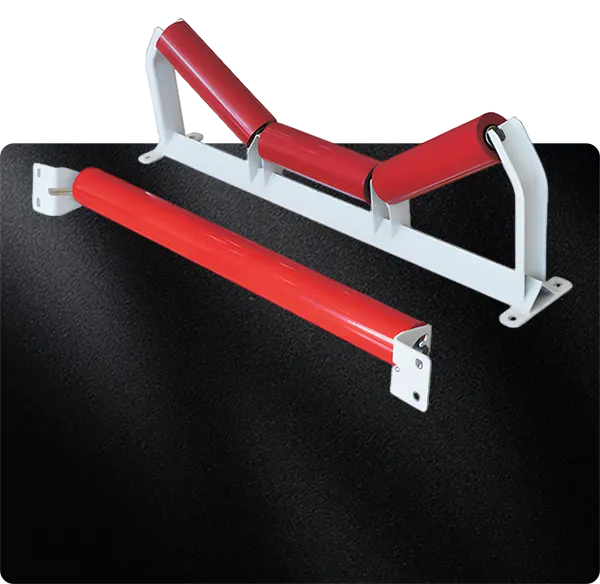
Troughing Idler
Carrying-side support, 20°/35°/45° trough angles.
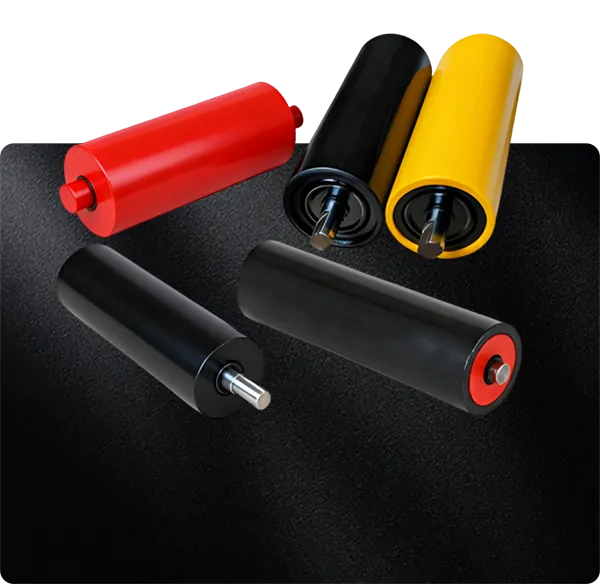
Carrying / Return Idler
Flat carry and return duty, standard and heavy-wall tube.
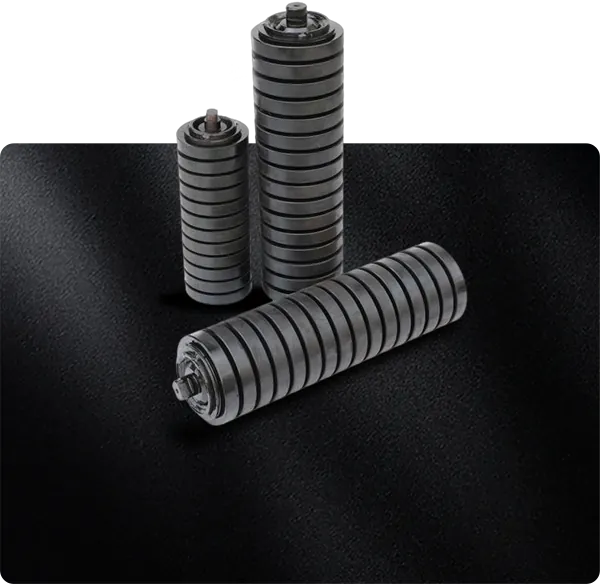
Impact Roller
Rubber-ring cushioning at the loading point.
Conveyor Pulleys
Drive, bend, tail & snub pulleys — with rubber, ceramic or herringbone lagging to your spec.
Conveyor Belts
EP/NN, steel cord, heat, oil and abrasion resistant covers. 17 types for different duties.
Cleaners & Impact Beds
Belt cleaners, impact beds, skirt seals — the parts that decide whether your idlers survive.