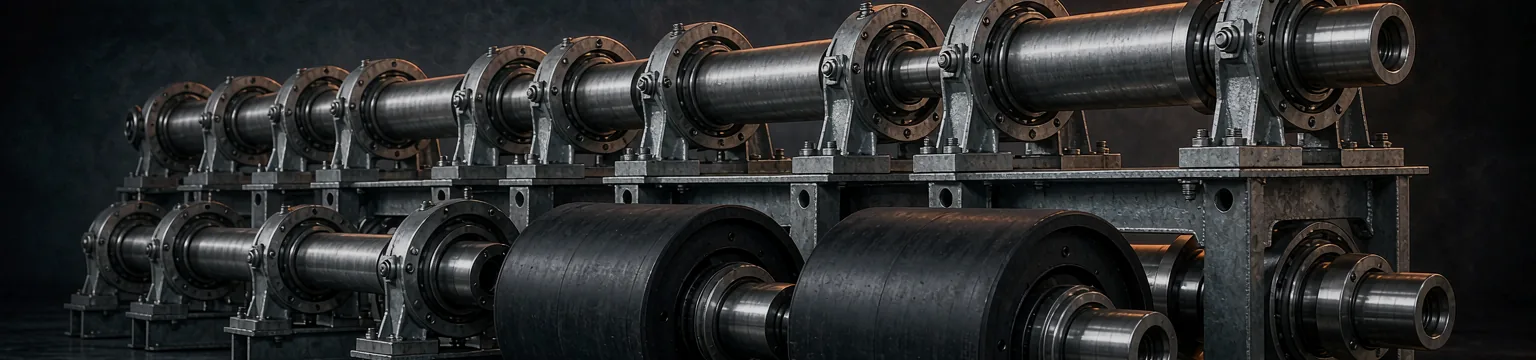
Primary or Secondary? A Conveyor Belt Cleaner Selection Guide
Carry-back is not housekeeping — it is what destroys tail pulleys and return rollers. How to choose a primary, a secondary or a plough, and how to set it correctly.
Key Takeaways
- Carry-back is not housekeeping. Material stuck to the return strand is pressed into return rollers and the tail pulley, and that is where belt damage and tracking faults start.
- Primary removes the bulk, secondary removes the film. One without the other leaves half the problem.
- Blade material is decided by the splice and the belt cover, not by the material being conveyed.
- A plough is for spillage, not for carry-back. Fitting one where a cleaner is needed solves nothing.
- Cleaner tension is a setting, not a guess. Too loose cleans nothing; too tight wears the belt and the blade.
The Real Cost of Carry-Back
Every belt carries a film of material back along the return strand. On a 1,200 mm conveyor moving 900 t/h, even a thin film is a continuous stream of fines being deposited under the belt, on the floor, and into the return rollers and tail pulley.
The consequences stack up in a predictable order:
- Build-up on the tail pulley — the pulley becomes a taper, and the belt starts to steer. This is the most common cause of tracking problems on an otherwise aligned conveyor.
- Return roller wear — abrasive fines packed against a roller face act as a grinding paste.
- Belt damage — material trapped between belt and pulley bruises the cover and can start a longitudinal rip.
- Housekeeping labour — the cost that is easy to measure and easiest to ignore.
Primary, Secondary, Plough: Three Different Jobs
| Device | Position | Removes | Best for |
|---|---|---|---|
| Primary cleaner | On the head pulley, just past the tangent point | The bulk of the carry-back, as the belt leaves the pulley | Every conveyor that carries material with any fines content |
| Secondary cleaner | 150–250 mm further along the return strand | The thin film the primary leaves behind | Sticky material, wet material, strict housekeeping, or where the tail pulley is showing build-up |
| Plough / V-plough | On the return strand ahead of the tail pulley | Material that has already fallen onto the belt | Any conveyor with spillage, a reversing tail, or an enclosed tail area |
| Brush roller | Return strand | Dry, fine, non-sticky dust | Grain, sawdust, light aggregates — poor on damp or sticky material |
Blade Material: Carbide, Polyurethane or Rubber
| Blade | Life | Belt friendliness | Choose it when |
|---|---|---|---|
| Tungsten carbide | Longest — months to years depending on abrasion | Good on sound belt, less forgiving of proud splices | Abrasive bulk material, high belt speed, infrequent maintenance access |
| Polyurethane | Shorter, but predictable | Very good — no risk of cutting the cover | Mechanical splices, thin belt covers, low tension, or where belt damage is unacceptable |
| Rubber | Shortest | Good | Light duty, dry fines, low cost priority |
The decision rule most plants settle on: carbide on fabric and steel cord belts with vulcanised splices; polyurethane wherever there is a mechanical splice, a thin cover, or a belt that is already showing cover damage.
Tensioning: The Setting That Decides the Result
A cleaner blade has to be held against the belt with enough force to scrape, and not so much that it wears the belt or the blade. Three mechanisms are used:
| Type | How it maintains contact | Notes |
|---|---|---|
| Spring tensioned | Springs keep pressure as the blade wears | Simple and self-adjusting; check spring condition at each inspection |
| Counterweighted | A weight on an arm maintains pressure | Easy to see the setting; needs space alongside the pulley |
| Pneumatic | Air cylinder with regulated pressure | Most controllable and adjustable on the run; needs an air supply and a regulator |
Whatever the mechanism, the setting is a number in the manual, not a judgement in the field. Over-tensioning is more common than under-tensioning, because a cleaner that is not cleaning gets tightened until it does — and the belt pays for it.
Installation Position: Small Distances, Large Consequences
- Primary — mounted on the head pulley at the point where the belt has just left the pulley surface but is still supported by it. Too far around and the belt has already started to flatten; too close and the blade fouls the pulley.
- Secondary — far enough downstream that the belt is on its own, typically 150–250 mm, and positioned where the return strand is supported and not sagging.
- Blade angle — set to the belt speed and the blade type. A blade angle that is correct at 1 m/s is wrong at 4 m/s, which is why the belt speed belongs in the enquiry.
- Access — a cleaner that cannot be reached for inspection will not be inspected. If the installation makes access difficult, the blade will be run until it stops cleaning rather than until it needs changing.
Matching the Cleaner to the Belt Width
| Belt width | Typical cleaner width | Notes |
|---|---|---|
| 650 mm | 500 mm | Single-piece blade common |
| 800 mm | 650 mm | Single-piece blade common |
| 1000 mm | 800 mm | Segmented blade begins to be preferred |
| 1200 mm | 1000 mm | Segmented blade, individually spring loaded |
| 1400 mm | 1200 mm | Segmented, with a centre support |
| 1600 mm | 1400 mm | Segmented, centre support, heavier frame |
| 2000 mm | 1800 mm | Segmented, multiple supports |
Segmented blades matter on wide belts for two reasons: one worn section can be replaced without removing the whole assembly, and each segment follows the belt independently, so a slight belt deviation does not lift the entire blade off the surface.
Common Mistakes We See on Site
| Mistake | Symptom | Fix |
|---|---|---|
| Fitting a cleaner to cure spillage at the loading point | Belt is clean at the head, still spilling at the tail | Seal the skirt and chute first |
| Carbide blade on a belt with a proud mechanical splice | Blade and splice both damaged within weeks | Polyurethane blade, or re-splice |
| Blade over-tensioned | Belt cover wear in a line across the width; short blade life | Reset to the specified tension |
| Primary fitted without a secondary on sticky material | Thin film still reaching the tail pulley | Add a secondary cleaner |
| No plough ahead of a reversing tail | Material drawn into the tail pulley on reverse | Fit a V-plough |
FAQ
Do I need both a primary and a secondary cleaner?
On dry, free-flowing material and a short conveyor, a primary alone is often enough. On sticky or wet material, or where the tail pulley shows any build-up, a secondary pays for itself quickly — it is the film, not the bulk, that causes the build-up.
Will a carbide blade damage my belt?
Not if the blade is set correctly and the splice is not proud. Carbide is the long-life choice on fabric and steel cord belt with vulcanised splices. It is the wrong choice on a mechanical splice or a thin cover, where polyurethane is safer.
How often do blades need changing?
Abrasive ore on a fast belt can wear a carbide blade out in three to six months. Grain can run for years. Because blades are segmented and spring tensioned, adjustment takes minutes; replacement is a scheduled task, not a breakdown.
Can I retrofit a cleaner to an existing conveyor?
Almost always. What is needed is the belt width, the belt speed, the pulley diameter and the available space at the head. Retrofits are the majority of cleaner orders — conveyors are rarely designed with cleaners in mind from the start.
Does a cleaner help belt tracking?
Indirectly and often decisively. If build-up on the tail pulley is what is steering the belt, cleaning the belt removes the cause. Before adjusting any idler to fix tracking, check whether the tail pulley is carrying material — see why conveyor belts run off centre.
Send Us Your Duty — We Will Return a Build
Belt width, speed, material, tonnage, temperature and environment. We come back with the build, drawings and a quotation.
Related Guides
Why Your Conveyor Belt Runs Off Centre: 9 Causes, in the Order to Check Them
A belt does not wander; it is steered. Find the cause in the right order — build-up, loading point, structure, pulleys, idlers, camber, splice, tension — before touching an idler.
How to Measure a Conveyor Roller for Replacement — Without the Drawing
The drawing is gone and the line is down. Six measurements and one photo define a roller completely — here is how to take them and what to send with the enquiry.
Rubber, Diamond or Ceramic: Choosing Conveyor Pulley Lagging
Lagging sets the friction that decides how much tension the drive can transmit. Rubber, diamond groove or ceramic — and why the bonding method matters more than the material.
Where to Go Next
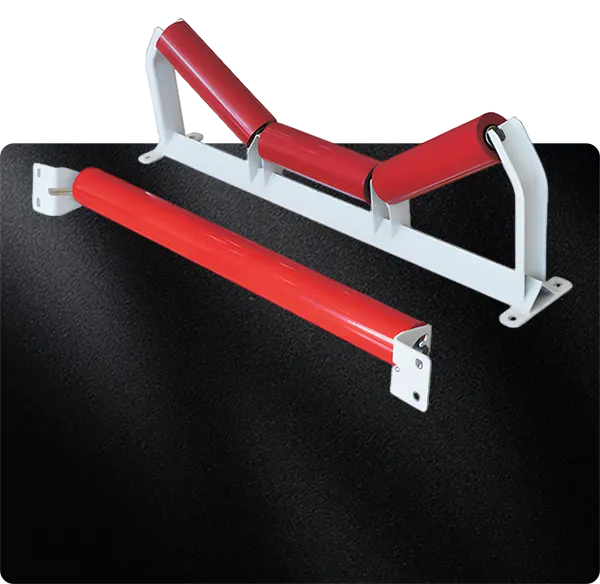
Troughing Idler
Carrying-side support, 20°/35°/45° trough angles.
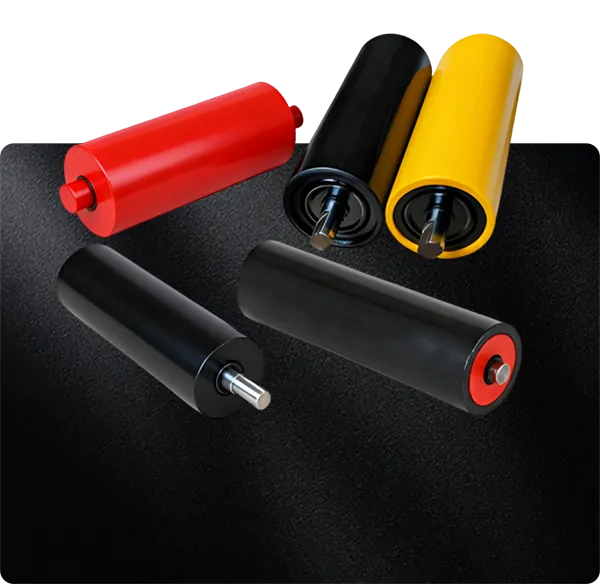
Carrying / Return Idler
Flat carry and return duty, standard and heavy-wall tube.
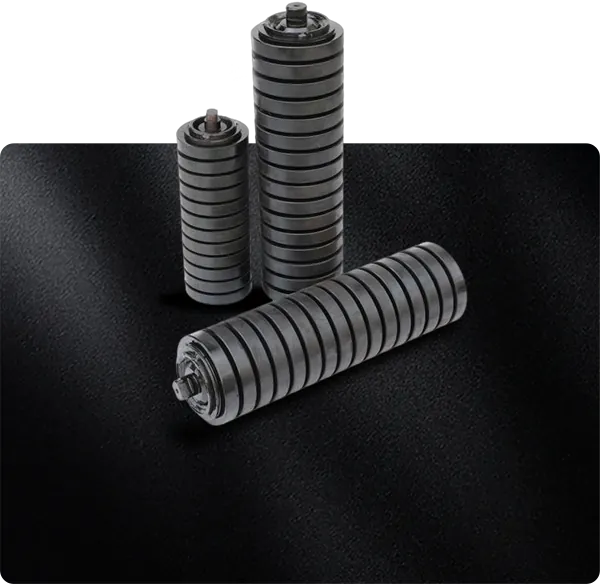
Impact Roller
Rubber-ring cushioning at the loading point.
Conveyor Pulleys
Drive, bend, tail & snub pulleys — with rubber, ceramic or herringbone lagging to your spec.
Conveyor Belts
EP/NN, steel cord, heat, oil and abrasion resistant covers. 17 types for different duties.
Cleaners & Impact Beds
Belt cleaners, impact beds, skirt seals — the parts that decide whether your idlers survive.