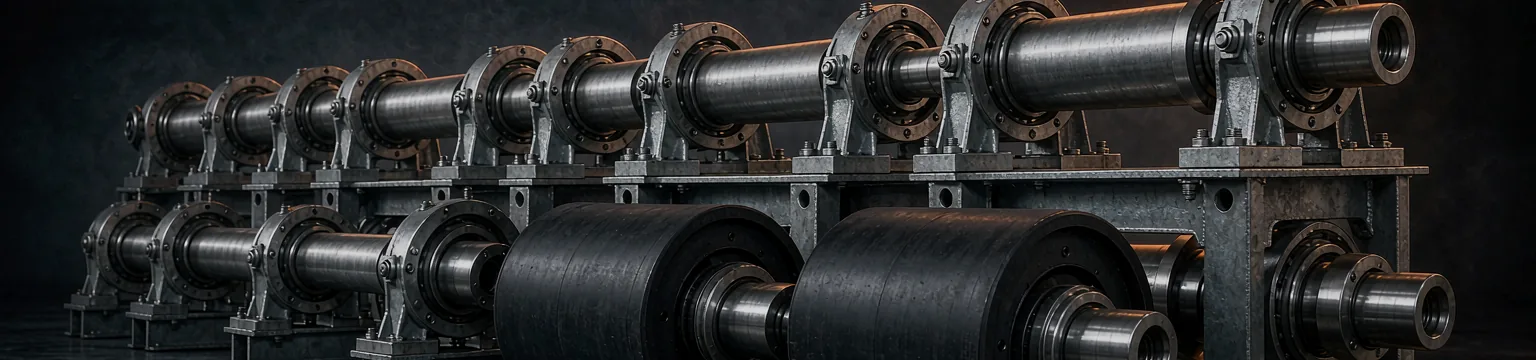
Impact Beds for Belt Conveyors Rubber Bars Where Rollers Are Not Enough
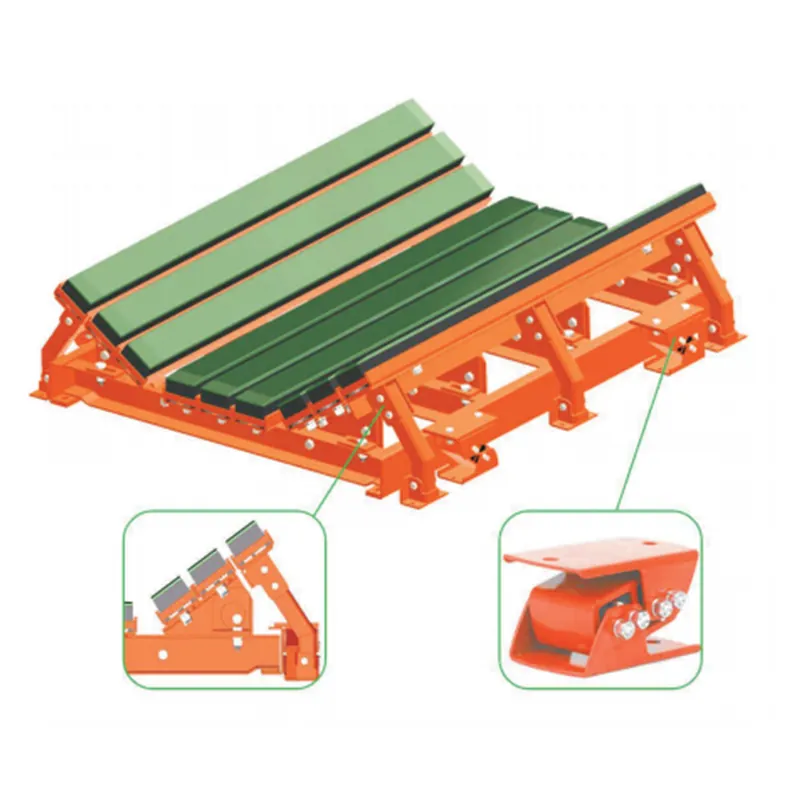
Impact beds with rubber bars on a steel frame for high drops and large lump. Continuous full-width belt support, bars replaced individually.
An impact bed supports the belt continuously across its full width at the loading point, using rubber bars on a steel frame instead of rollers. Where an impact roller gives point contact at each station, a bed spreads the load over the whole area under the chute, which is the lowest point loading the belt can be given.
It is the right answer when the drop is severe, the lump is large, or the belt is a construction that cannot tolerate a point load. It is not the right answer everywhere: a bed costs more upfront, it is harder to service, and on a moderate drop two or three impact rollers do the same job for less.
What You Are Actually Getting
| Parameter | Specification |
|---|---|
| Construction | Rubber bars mounted on a steel frame, supporting the belt continuously |
| Contact | Continuous across the full belt width - the lowest point loading available |
| Consumable | Rubber bars, replaced individually. No bearings to fail |
| Bed length | 1000 - 3200 mm depending on belt width and the severity of the drop |
| Belt width range | 650 - 2000 mm in the standard series |
| Frame | Steel, bolted to the conveyor structure at the loading point |
| Application | Large lump, high drop height, high capacity - where impact rollers are not enough |
| Comparison | Lower point loading than rollers, higher upfront cost, harder to service |
Impact Bed or Impact Rollers
Both protect the belt at the loading point. The difference is contact area, cost and maintenance - and there is a drop height above which rollers stop being viable.
| Criterion | Impact bed (rubber bars on steel frame) | Impact rollers |
|---|---|---|
| Contact area | Continuous - supports the full belt width | Point contact at each roller |
| Best for | Large lump, high drop height, high capacity | Moderate lump, tight spaces, lower cost |
| Effect on belt | Lowest point loading; minimal cover damage | Higher point loading; can bruise the cover on very large lump |
| Maintenance | Rubber bars replaced individually; no bearings to fail | Rollers replaced; bearings are the wear item |
| Relative cost | Higher upfront | Lower upfront, higher over the belt life in severe duty |
The cost comparison has to be over belt life, not over the purchase order. A failed belt costs a shutdown; a worn bar costs a bar.
What to Get Right at Specification
Bed length follows the drop
The bed has to be long enough for the material stream to settle. Too short and the belt is unprotected at the far end of the impact zone, which is where the damage then appears.
Bars are the consumable
The frame lasts; the bars wear. A bed whose bars cannot be replaced individually is a bed that has to be rebuilt, which is the main thing to check before buying.
Access for bar changes
This is the weakness of a bed compared with rollers. Design the access at the same time as the bed, or the bars will not get changed on schedule.
Not a substitute for chute design
A bed protects the belt from a drop it cannot avoid. Material landing on the belt edge, or a drop of several metres, is a chute geometry problem - the bed will just be destroyed more slowly than rollers.
Belt construction
On a steel cord belt, a bed is often the only acceptable solution at a high-impact point, because rollers concentrate load on the cords. Check the belt construction before choosing.
Where a Bed Replaces Rollers
- Primary crusher discharge — Large, sharp, heavy lump at an uncontrolled drop. The bed spreads the load where rollers would be destroyed.
- High-capacity transfer towers — Where the tonnage and the drop together exceed what a roller can take.
- Steel cord belt loading points — Point loading on steel cord is a specific risk. A bed is the safer specification.
Impact Beds for Belt Conveyors FAQ
Impact bed or impact rollers?
A bed where the drop is severe, the lump is large or the belt is steel cord. Rollers where the drop is moderate and cost matters - they are cheaper upfront and easier to service.
How long should the impact bed be?
Long enough for the material stream to settle, which is why the standard range runs from 1000 to 3200 mm against belt width. Send the drop height and the lump size and the length can be set properly.
What wears out?
The rubber bars. They are replaced individually on a well-designed bed, and there are no bearings to fail - which is the one clear maintenance advantage over rollers.
Can I fit a bed to an existing conveyor?
Usually, if there is structure to mount to and access for bar changes. The access is the practical constraint, so check it before ordering.
How Orders Run
T/T — 40% deposit with order, 60% balance before shipment. L/C at sight accepted for container orders.
Quoted per order. The schedule depends on the drawing, the quantity and the material — we state a firm date with the quotation instead of a catalogue figure.
15 months from B/L date against manufacturing defects. Claims supported by photos and batch number.
Packing, minimum order and Incoterms are set out in full on the quotation page.
Impact Beds for Belt Conveyors Built to Your Drawing
Send the belt width, the duty and, if you have one, the drawing. We will specify it, quote within 24 hours, and ship samples in 2–3 days.
Talk to Our Engineers