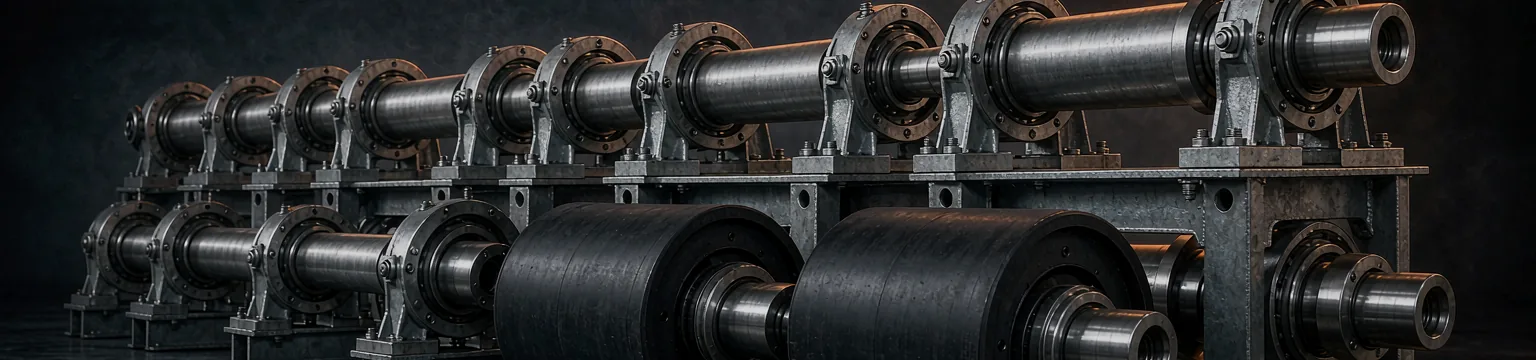
Conveyor Belt Cleaners Primaries, Secondaries and Belt Scrapers
Conveyor belt cleaners and belt scrapers in tungsten carbide and polyurethane, plus V-ploughs and brush rollers. Sized to belt width from 650 to 2000 mm.
A belt cleaner - or belt scraper - removes carry-back from the belt at the head pulley before it travels back along the return run. Everything downstream - return idlers, tail pulley, the floor under the conveyor - is affected by whether this works. It is the cheapest component on the conveyor and the one that decides how often you replace the ones that are not.
The order of the components matters. A primary cleaner removes the bulk. A secondary, 150 to 250 mm further along, takes the fine residue the primary leaves. A plough catches what has already dropped onto the belt. Fitting a secondary without a working primary means paying twice for the same job.
What You Are Actually Getting
| Parameter | Specification |
|---|---|
| Blade materials | Tungsten carbide (long life, abrasive duty) or polyurethane (where a metal blade would damage the belt) |
| Primary position | On the head pulley, just past the tangent point |
| Secondary position | 150 - 250 mm further along, on the return strand |
| Plough | V-plough on the return strand before the tail pulley, single or double blade |
| Brush roller | Return strand, dry fine non-sticky dust only |
| Belt width range | 650 - 2000 mm in the standard series |
| Blade width | Sized to the belt, not to the catalogue - see the table |
| Mounting | Bolted to the conveyor structure at the head; needs access for blade adjustment |
Which Cleaner Does Which Job
Four components, two jobs: removing carry-back at source, and catching what was missed. They are not alternatives to each other.
| Cleaner | Position | Removes | Best for |
|---|---|---|---|
| Primary - tungsten carbide blade | On the head pulley, just past the tangent point | Bulk of the carry-back | Abrasive bulk material, high speed, long life between changes |
| Primary - polyurethane blade | On the head pulley | Bulk of the carry-back | Where a metal blade would damage the belt: mechanical splices, thin covers |
| Secondary - carbide or PU | 150 - 250 mm further along, on the return strand | Fine residue left by the primary | Sticky clay, wet material, plants with strict housekeeping |
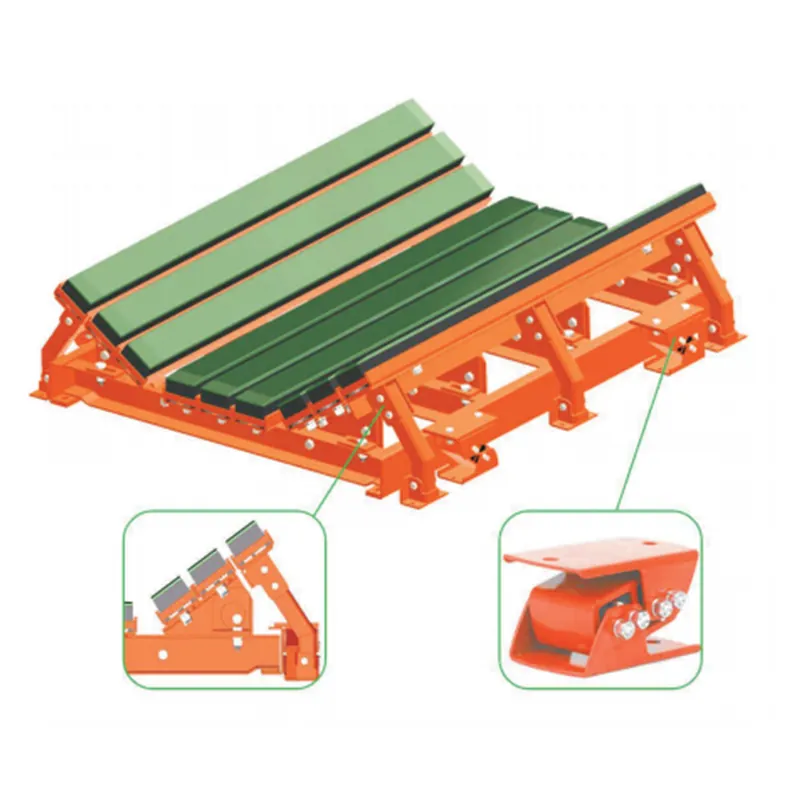
| Plough / V-plough | On the return strand before the tail pulley | Material that has already dropped onto the belt | Any conveyor with a spillage problem or a reversing tail |
| Belt brush roller | Return strand | Dry, fine, non-sticky dust | Grain, sawdust, light aggregates |
Carbide lasts longer and is the default on abrasive bulk material. Polyurethane is the correct choice where a metal edge would damage a mechanical splice or a thin cover.
Sizing and Setup Decide the Result
Size to the belt, not the catalogue
A cleaner narrower than the belt leaves two strips of carry-back at the edges, and those strips are what destroy the return idlers. The blade width follows the belt width, as in the table.
Blade pressure is a compromise
Too little and it does not clean. Too much and it wears the blade and the belt cover. It needs adjusting after the belt has run for a while, which means access has to be designed in.
Carbide or polyurethane
Carbide for abrasive bulk and long life. Polyurethane where the belt has a mechanical splice or a thin cover that a metal edge would catch and damage.
Primary before secondary
A secondary cleaner cannot make up for a primary that is not working. Fix the primary first - adding a secondary is the most common wasted purchase on a conveyor.
Plough is a backstop
A V-plough catches material that has already fallen onto the return strand. It does not clean the belt. If you need a plough, the primary cleaner upstream is not doing its job.
Matching the Component to the Belt Width
- Abrasive bulk material — Carbide primary plus a carbide secondary. This is the standard arrangement on ore, cement and aggregate.
- Mechanical splices or thin covers — Polyurethane primary. A carbide blade will catch a splice and damage both the blade and the belt.
- Reversing conveyors — A plough before the tail rather than a fixed blade, because the belt runs backwards through the cleaning point.
- Grain and light aggregate — Brush roller for dry fine dust, with a plough as backstop.
Conveyor Belt Cleaners FAQ
Do I need a primary and a secondary cleaner?
Usually yes on any conveyor with significant carry-back. The primary removes the bulk and the secondary takes the residue. A secondary alone is a waste - it cannot do the primary's job.
Carbide or polyurethane blades?
Carbide for abrasive bulk, high speed and long intervals between maintenance. Polyurethane where the belt has mechanical splices or a thin cover that a metal edge would damage.
How wide should the cleaner be?
Sized to the belt width, as in the table - not to the nearest catalogue size below it. A cleaner narrower than the belt leaves carry-back at both edges, which is exactly where it does the most damage.
Can I fit a cleaner to an existing conveyor?
Yes, if there is structure to bolt to at the head and access to adjust the blade. Access is the constraint that decides feasibility, so check it before ordering.
How Orders Run
T/T — 40% deposit with order, 60% balance before shipment. L/C at sight accepted for container orders.
Quoted per order. The schedule depends on the drawing, the quantity and the material — we state a firm date with the quotation instead of a catalogue figure.
15 months from B/L date against manufacturing defects. Claims supported by photos and batch number.
Packing, minimum order and Incoterms are set out in full on the quotation page.
Conveyor Belt Cleaners Built to Your Drawing
Send the belt width, the duty and, if you have one, the drawing. We will specify it, quote within 24 hours, and ship samples in 2–3 days.
Talk to Our Engineers