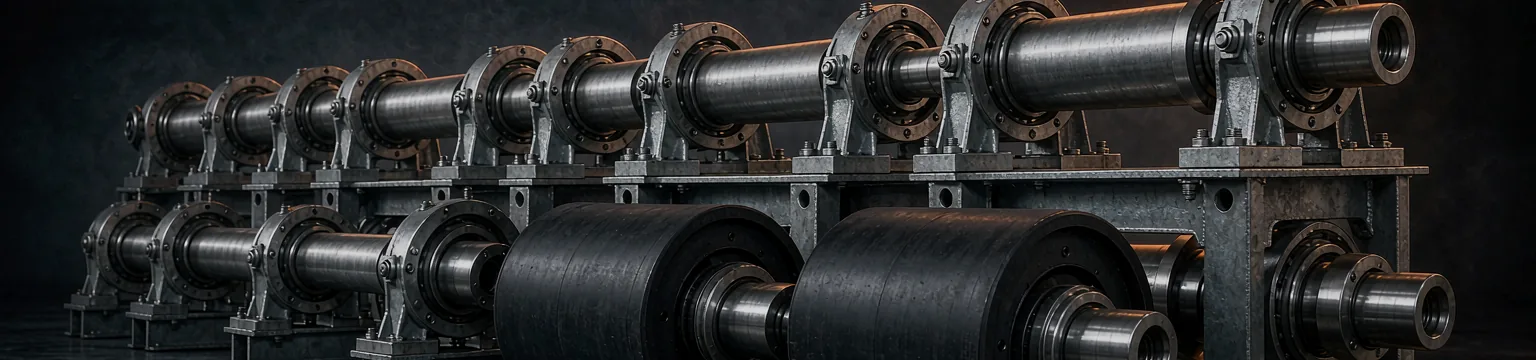
Garland Idlers Linked Rolls for Impact and Uneven Loading
Garland idlers with linked rolls that flex under impact and follow an uneven belt. For high-impact loading zones and long conveyors, built to your belt width.
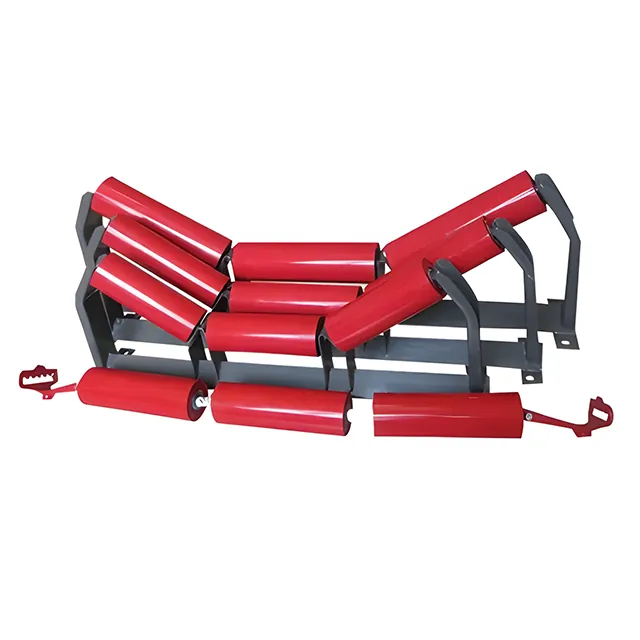
A garland idler, also called a catenary idler, suspends its rolls on flexible links or a chain instead of fixing them in a rigid frame. Each roll can move independently, so the set follows the belt rather than forcing the belt to follow the frame. Under a heavy lump the whole train deflects, spreading the load across several rolls.
The trade-off is real. A garland set absorbs impact and tolerates a badly aligned structure far better than a rigid troughing set, but it also lets the belt sag more between stations and it is harder to inspect roll by roll. It tends to be specified where the material is heavy and the structure is long, or where impact would otherwise destroy a rigid frame.
What You Are Actually Getting
| Parameter | Specification |
|---|---|
| Construction | Rolls suspended on flexible links or chain, in a catenary geometry |
| Roll diameter | 89.1 / 114.3 / 139.8 / 165.2 mm standard; to drawing outside that |
| Configuration | Three-roll, five-roll, or return-side garland depending on belt width and duty |
| Tube | Q235 steel, equivalent to SS400 / S275JR |
| Shaft | 45# steel, equivalent to DIN C45 / JIS S45C / AISI 1045 |
| Bearing | Deep-groove ball 6204 - 6310, HRB or ZWZ standard, SKF or FAG on specification |
| Link | Chain or flexible link, sized against the belt load at that width |
| Duty | High-impact loading, uneven structure, long conveyors with settlement |
Garland Idler Sizing Against Belt Width
Garland sets use the same roll diameter series as the rigid stations at each belt width. The roll count in the train, not the roll diameter, is what changes with duty.
| Belt width | Roll dia. | L per roll | Weight per roll | Typical roll count |
|---|---|---|---|---|
| 400 | 89.1 | 145 | 5.9 | 3 |
| 500 | 89.1 | 180 | 6.5 | 3 |
| 600 | 89.1 | 210 | 8.7 | 3 |
| 750 | 114.3 | 265 | 11.4 | 3 |
| 900 | 114.3 | 315 | 12.6 | 3 - 5 |
| 1050 | 139.8 | 370 | 20.6 | 3 - 5 |
| 1200 | 139.8 | 420 | 22.3 | 3 - 5 |
| 1400 | 165.2 | 500 | 44.1 | 5 |
| 1600 | 165.2 | 580 | 49.9 | 5 |
| 1800 | 165.2 | 650 | 63.3 | 5 |
| 2000 | 165.2 | 730 | 67.6 | 5 |
| 2200 | 165.2 | 800 | 93.5 | 5 |
| 2400 | 165.2 | 880 | 100.8 | 5 |
Dimensions in mm, weight in kg per roll. Roll count refers to the number of rolls in the flexible train; the exact geometry is set against the belt width and the trough profile you need.
Garland Versus Rigid Troughing Set
Impact absorption
The flexible train deflects under a lump and returns, which spreads impact across several rolls. In a rigid set the nearest roll takes almost all of it - which is why garland sets are specified at transfer points where an impact bed is not practical.
Tolerance of a settled structure
A long conveyor on a settling foundation goes out of line slowly. A garland train follows it; a rigid frame fights it and starts wearing belt edges.
Sag between stations
The same flexibility that absorbs impact lets the belt sag more. Spacing has to be tighter than for a rigid set at the same belt width, which partly cancels the cost saving.
Maintenance
Each roll is a separate part on a link, so replacement is quick once access is arranged - but inspection roll by roll is slower than looking along a rigid frame. For conveyors in remote locations that is a real consideration.
Noise
Flexible links transmit less structure-borne noise than a welded frame. Relevant in enclosed galleries and near residential boundaries.
Where Garland Idlers Are Specified
- Stockyard and yard conveyors — Long, low-speed, heavy lump, structure that settles. The classic garland application.
- Transfer points without room for a bed — Where an impact bed will not fit, a garland train absorbs impact over a longer distance than two or three rigid impact rolls.
- Mine and quarry primary haulage — Heavy, sharp lump at high load. Flex in the train prevents the single-roll failure that ends a rigid set.
Garland Idlers FAQ
What is the difference between a garland idler and a catenary idler?
None - the names are interchangeable, and both describe rolls suspended on flexible links. Some regions say catenary, others garland, and some suppliers use both in the same catalogue.
Are garland idlers better than rigid troughing sets?
Better at absorbing impact and at tolerating a misaligned structure. Worse on belt sag, inspection and - usually - unit price. They are a solution to a specific problem, not an upgrade across the board.
How many rolls should the train have?
Three for most belt widths; five where the belt is wide enough that a three-roll train cannot form the trough profile you need. It follows the belt width and the trough angle, not preference.
Can garland sets be used on the return side?
Yes. Return-side garland trains exist for the same reasons - impact and structure tolerance - but they are less common, because the return side carries less load and a plain return roll is usually sufficient.
How Orders Run
T/T — 40% deposit with order, 60% balance before shipment. L/C at sight accepted for container orders.
Quoted per order. The schedule depends on the drawing, the quantity and the material — we state a firm date with the quotation instead of a catalogue figure.
15 months from B/L date against manufacturing defects. Claims supported by photos and batch number.
Packing, minimum order and Incoterms are set out in full on the quotation page.
Garland Idlers Built to Your Drawing
Send the belt width, the duty and, if you have one, the drawing. We will specify it, quote within 24 hours, and ship samples in 2–3 days.
Talk to Our Engineers