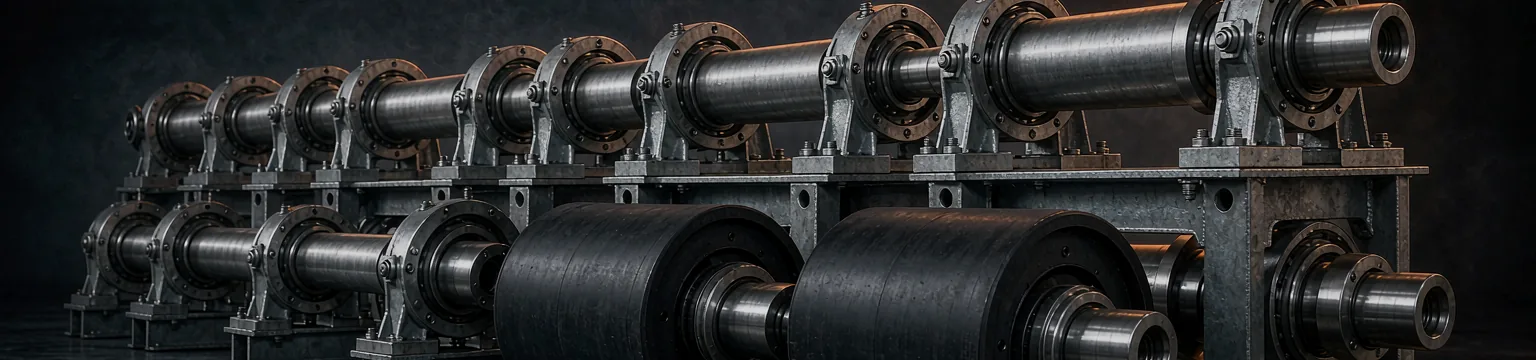
HDPE and UHMWPE Conveyor Rollers Polymer Shells for Corrosion and Build-Up
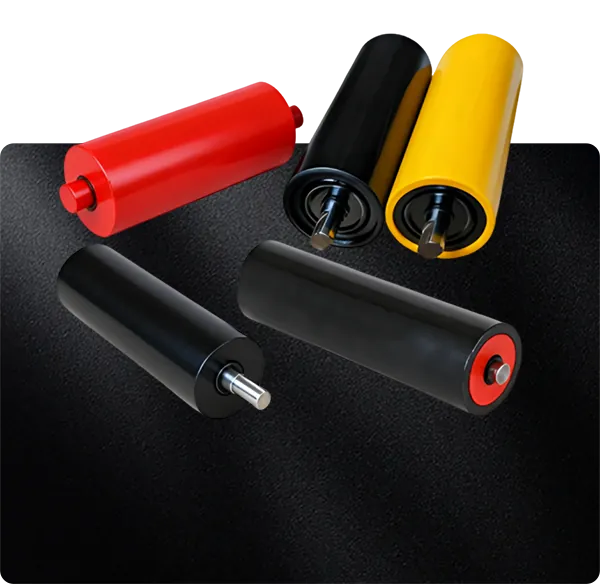
HDPE and UHMWPE conveyor rollers for corrosive, sticky and wash-down duty. Polymer shell over a steel shaft, non-marking and quiet, to your size.
An HDPE or UHMWPE roller replaces the steel tube with a polymer shell over a steel shaft. The point is not strength - steel is stronger - but the surface. Polymer does not rust, does not hold a magnetic charge that attracts fines, and releases sticky material that would bond to a painted steel tube.
The two polymers are not interchangeable. HDPE is the tougher, cheaper option with better impact resistance; UHMWPE has the lower friction coefficient and the better wear resistance, which is why it is the usual choice where material sticks. Both have a lower temperature ceiling than steel, and that limit decides whether they can be used at all.
What You Are Actually Getting
| Parameter | Specification |
|---|---|
| Shell | HDPE or UHMWPE tube over a steel shaft |
| Shaft | 45# steel, equivalent to DIN C45 / JIS S45C / AISI 1045 |
| Bearing | Deep-groove ball, sealed. HRB or ZWZ standard, SKF or FAG on specification |
| Temperature | Polymer duty is below the steel roll's grease range - tell us the ambient and the material temperature before specifying |
| Duty | Wet, corrosive, sticky, non-marking and low-noise applications |
| Mounting | Built to the same bracket centres as a steel roll at that belt width |
| Options | Also available in nylon, polyurethane and polymer silent grades - see the material comparison below |
Choosing the Shell Material
Four shells cover most of what a steel roll cannot do. This is a decision table, not a specification table: the right answer depends on what the conveyor carries and where it sits.
| Shell | Where it wins | Where it fails | Typical use |
|---|---|---|---|
| Carbon steel | Load capacity, temperature, cost per unit | Rusts; sticky material bonds to the painted face | General bulk handling, dry and clean |
| HDPE | Tough, non-marking, good impact resistance, lowest cost of the polymers | Lower wear resistance than UHMWPE; softer surface | Wash-down plants, light duty, non-marking needs |
| UHMWPE | Lowest friction, best release of sticky material, high wear resistance | Higher cost; temperature ceiling below steel | Wet sticky fines, fertiliser, clay, sludge |
| Nylon | Hard wearing, good load capacity for a polymer, low noise | Absorbs moisture and can grow in dimension; more expensive | Indoor plants, noise-sensitive sites, moderate load |
| Polyurethane | Excellent abrasion resistance with quiet running | Cost; not for high temperature | Abrasive fines where a steel roll wears through |
Material choice follows the material carried and the environment, not the belt width. Tell us both and we will recommend a shell rather than quote all four.
What Polymer Rollers Are Actually For
Build-up, not corrosion
Corrosion is visible and gets dealt with. Build-up is invisible until the belt starts tracking badly and the roll is out of round. UHMWPE addresses build-up, which is the more common and more expensive failure.
Non-marking duty
In food, paper and textile plants a steel roll leaves a mark on the product. Polymer does not. That is often the deciding factor, ahead of wear life.
Temperature ceiling
Polymer shells have a lower working temperature than a steel roll with high-temperature grease. On clinker, sinter or coke duty they are simply not an option, whatever the friction benefit would be.
Load capacity
A polymer shell carries less load than a steel tube of the same diameter. On wide belts with heavy material the diameter has to go up, or the roll count up, to compensate.
Static
Polymer shells do not dissipate static the way a steel shell does. In an explosive-dust environment that matters, and it needs to be raised before the order rather than after.
Where Polymer Shells Are the Right Answer
- Wash-down and hygiene plants — Food, beverage and pharmaceutical conveyors that are cleaned with water. Steel rusts at the bearing seat; polymer does not.
- Fertiliser and salt — Hygroscopic and corrosive. UHMWPE sheds the material and survives the environment.
- Noise-sensitive sites — Polymer shells and nylon rolls run quieter than steel. Relevant indoors, near boundaries, and in enclosed galleries.
HDPE and UHMWPE Conveyor Rollers FAQ
HDPE or UHMWPE?
UHMWPE where the material sticks or the wear is severe - it releases better and wears longer. HDPE where the requirement is non-marking, wash-down resistance and cost. If the material is not sticky, HDPE is usually enough.
Can a polymer roller replace a steel roller directly?
Usually on the same mounting centres, yes, but check the load. A polymer shell at the same diameter carries less than steel, so on a heavily loaded station you may need a larger diameter or a tighter spacing.
What is the temperature limit?
It depends on the polymer and on the bearing grease, and the lower of the two governs. Tell us the ambient and the material temperature and we will confirm whether a polymer shell is viable before quoting.
Are these the same as UHMWPE idlers and plastic rollers?
Yes - plastic roller, polymer roller, UHMWPE roller and HDPE roller are used loosely in the trade. The material grade is what matters, so ask for it in writing rather than accepting the generic name.
How Orders Run
T/T — 40% deposit with order, 60% balance before shipment. L/C at sight accepted for container orders.
Quoted per order. The schedule depends on the drawing, the quantity and the material — we state a firm date with the quotation instead of a catalogue figure.
15 months from B/L date against manufacturing defects. Claims supported by photos and batch number.
Packing, minimum order and Incoterms are set out in full on the quotation page.
HDPE and UHMWPE Conveyor Rollers Built to Your Drawing
Send the belt width, the duty and, if you have one, the drawing. We will specify it, quote within 24 hours, and ship samples in 2–3 days.
Talk to Our Engineers