Key Takeaways
- A seized idler is almost never a bearing quality problem. It is a sealing, lubrication or specification problem that finally shows up as a bearing failure.
- Read the failed bearing before you order a replacement. Discolouration, grease condition and where the spalling sits will tell you which of the seven causes it was — ordering "the same again" repeats the failure.
- Contact seals make heat. On a dry, fast, dusty conveyor that heat is a common cause of premature seizure; a multi-stage labyrinth usually belongs there instead.
- C3 internal clearance is the conveyor default; C4 belongs on hot duty. A C0/CN-clearance bearing pressed into a tight housing often ends up preloaded from day one — and on clinker, sinter or coke, C3 is not enough either.
- The cost of a seizure is not the roller. It is belt cover damage, spillage, access time — and on an overland conveyor, lost throughput.
Worn Out or Seized: These Are Two Different Events
An idler that has worn out thins gradually. The shell loses wall thickness to abrasion, runout grows, and one day it is out of tolerance. It is predictable, it is measurable, and it belongs on a planned replacement list.
An idler that has seized stops rotating while the belt keeps running. The belt now slides over stationary steel: the shell wears a flat spot in minutes, the belt cover over that position is abraded and heated, spillage builds up underneath, and in coal, biomass or grain handling the hot stationary shell is a genuine ignition source. One seized roller on a 3 km overland can cost more in belt damage than a full set of rollers on that flight.
The important difference is this: wear is a maintenance item, seizure is an incident — and seizure has a cause chain you can break. In almost every failure investigation, the bearing did not fail because it was a bad bearing. It failed because something upstream removed its lubrication, added heat, or loaded it in a direction it was not specified for.
Read the Bearing Before You Order the Replacement
Cut open one failed roller before you raise a purchase order. Ten minutes with a failed bearing tells you more than a week of speculating, and it prevents you from re-ordering the same failure.
| What you see | What it means | Where to look next |
|---|
| Grease hardened, black or crusty | Thermal degradation — the grease cooked | Roller rpm, seal type, ambient temperature |
| Races or balls blue / straw-brown | Sustained overheating | Load, speed, lubrication interval |
| Rust, water traces, pitted races | Water ingress past the seal | Seal type, washdown practice, drainage, spares storage |
| Fine dust packed inside the seal cavity | Seal geometry does not match the contaminant | Dry dust at speed usually needs a labyrinth, not a contact lip |
| Spalling concentrated on one side of the race | Misalignment or shaft deflection loading the bearing unevenly | Housing alignment, shaft diameter, frame condition |
| Indentations (false brinelling) on the raceway | Impact loading, or damage in transport and handling | Impact idlers at the loading point; packing and storage |
| Cage broken, balls worn flat | Severe over-speed or total lubrication failure | Recalculate rpm from actual belt speed |
Cause 1 — The Seal Does Not Match the Contaminant
This is the most common root cause we see, and it is a specification error rather than a quality one.
- Dry, fine dust at speed (cement, fly ash, grain, sinter): the enemy is ingress plus heat. A multi-stage labyrinth seal keeps dust out without contact friction, so it runs cool.
- Washdown, rain or slurry (port terminals, wash plants, fertiliser): the enemy is water. A contact seal keeps water out but generates friction and heat, so it belongs at lower speeds.
Seal choice is one of the build variables you set when you specify the roller — the full list is in our conveyor idler selection guide. The expensive mismatch is a contact seal running at 4 m/s in a dry cement plant. The lip friction adds heat on top of an already hot duty, the grease degrades, and the bearing seizes in an environment where a labyrinth would have run for years. Specify the seal by contaminant and speed, not by habit.
Cause 2 — Lubrication: Wrong Type, Wrong Quantity, or Past Its Life
Three separate mistakes hide under this heading:
- Wrong specification. Every grease has a continuous service temperature ceiling. On clinker, sinter or coke duty, that ceiling arrives long before the steel does.
- Wrong quantity. Over-greasing is as damaging as under-greasing — the bearing churns the excess and heats up.
- Expired life. On a sealed-for-life roller, the grease charge must survive the entire intended service life. That life is a function of speed and temperature, and it is shorter than most people assume.
Ask your supplier to state the grease type, its temperature range, and the expected relubrication interval at your belt speed. If they cannot, they have not calculated the roller life — they have only quoted a price. Our standard charge is a low-temperature lithium/semi-synthetic grease rated −40 °C to +120 °C continuous, with a lithium-complex option to +160 °C for clinker, sinter and coke duty; the full grease table is below.
Cause 3 — Internal Clearance Wrong for the Duty
A bearing fitted with an interference fit, then running warm, loses radial internal clearance before it carries a single tonne of load. Conveyor rollers therefore normally specify C3 clearance (greater than standard CN) for exactly this reason.
Fit a C0/CN-clearance bearing into a tight housing on a warm, fast conveyor and it starts life partly preloaded. It will run hot, the grease will degrade early, and it will seize — with no visible defect in the bearing itself. This is one of the cheapest things to get right and one of the easiest to get wrong, because it is invisible on a drawing.
C3 is the right default, but it is not always enough. On cement clinker, sinter and coke duty, on a conveyor with a wide seasonal temperature swing, or under a heavy press fit, C4 is the class that should be on the PO. The practical rule: C0 only on short, slow, cool flights; C3 by default; C4 where heat or fit demands more margin. Full comparison table below.
Cause 4 — Over-Speed
Bearing life is governed by speed as well as load, and roller speed follows directly from belt speed and diameter:
rpm = (belt speed in m/min) ÷ (π × roller diameter in m)
What the calculation does not tell you is which number is acceptable. Three published figures define the ceiling, and they mean quite different things:
| Figure | What it is | What it means on the PO |
|---|
| 500 rpm | CEMA basis speed — the speed at which idler load ratings and rated life are normally published | The catalogue figure is the L10 life at 500 rpm. Above it, life falls away faster than the load rating suggests. This is the design target. |
| 600 rpm | General engineering limit — the ceiling advised by Chinese and international idler standards and design handbooks | Past this, rotational resistance climbs sharply and service life drops steeply. If the duty needs more, increase the diameter to bring the speed down or move to a higher-grade design — never just run the standard roller faster. |
| 750 rpm | Limit for specific standards and special designs — BOS 613 among them | A ceiling only where the roller has been designed and rated for it. A standard roller at 750 rpm is outside its specification, whatever the belt is doing. |
The classic trap is a conveyor that was uprated: the belt speed went up years ago and the rollers never did. A ø108 mm roller under a 3.5 m/s belt turns at roughly 620 rpm — past the 600 rpm general limit, squarely in the zone where service life falls away. Stepping up to ø133 mm puts the same belt at about 500 rpm — the CEMA basis speed — for a marginal change in roller cost.
The reflex that causes this failure is re-ordering by the diameter on the old drawing. Check the rpm at the current belt speed instead. On a line that has been sped up, a diameter step is almost always cheaper than the belt damage and change-outs that follow a roller run past 600 rpm. For the full speed-to-diameter selection matrix, see our conveyor idler selection guide.
Cause 5 — Shaft Deflection and Housing Misalignment
A bearing is designed for load distributed across its raceway. Deflection under load, a twisted frame, or a thin shaft concentrates that load on one side — which is exactly why spalling often appears on one side of the race only. Specify shaft material and diameter, and treat frame alignment as part of the bearing's duty, not a separate issue.
Cause 6 — Water Ingress and Corrosion
In port terminals, wash plants and any outdoor conveyor in a wet climate, water wins eventually unless the seal is chosen for it. There is also standstill corrosion: a conveyor that sits idle for weeks gives water time to work past a seal that would have coped in continuous running. On seasonal or standby lines, specify for the idle condition, not the running one.
Cause 7 — Contamination During Assembly, and Bad Spares Storage
Clean assembly matters more than most people expect, and spares storage is where good rollers are ruined. Rollers stored outdoors, stacked on their seals, or left in packaging that traps water will often fail before the ones already in service. Store them dry, on the shaft ends, in the original packing.
A 15-Minute Field Check Before You Reorder
- Spin it by hand. Rough or gritty means contamination or damage; smooth-but-tight means lubrication or clearance.
- Listen along the flight. A squeal is often a stationary shell under a moving belt, not a noisy bearing.
- Look at the seal cavity. Dust packed around the seal tells you the seal lost that fight.
- Open one roller and read the grease. Colour and texture tell you heat or water.
- Check the shell for a flat spot. That confirms it seized while running, not after shutdown.
- Check the neighbours. One seized roller overloads the rollers either side of it — they are usually part-way down the same path.
- Note the position. Loading point means impact; a low point means water collects; the return side means carry-back — which is usually a belt cleaner problem rather than an idler problem.
What to Write Into the Next Purchase Order
| Item | Specify it as | Why it matters here |
|---|
| Bearing | Named brand (HRB / ZWZ / SKF / FAG) and clearance class — C3 default, C4 for hot duty | Prevents the preload failure in Cause 3, and removes the substitution risk |
| Grease | Type and continuous service temperature range (−40 °C to +120 °C standard; to +160 °C for clinker duty), plus relubrication interval | Cause 2 — and it is a question most suppliers cannot answer |
| Seal | By contaminant and speed, with the environment stated | Cause 1, the most common root cause |
| Shell wall | Thickness in mm, as a value not a range | The most frequent hidden downgrade in a cheap quotation |
| Shaft | Material and diameter | Deflection loads the bearing unevenly (Cause 5) |
| Runout | Total indicator reading in mm, measured after assembly | Vibration, noise and tracking |
| Duty statement | Belt speed (m/s), tonnage, environment, position on the conveyor | Without this, no supplier can calculate a life |
One useful question to put to any supplier: "Which CEMA class is this, and at what basis speed is the life rating published?" The answer should be the class and 500 rpm. A supplier who works from your duty data will give you both; a supplier who works from a price list will give you a catalogue.
Bearing and Grease: The Two Lines a Quotation Usually Leaves Out
Most quotations state the bearing as a single line — 6205-2RS — and stop there. That one line hides the two decisions that determine whether a roller runs 8,000 hours or 40,000. Below is what we build to, and the reasoning behind each choice, so you can put the same numbers into your own specification.
Bearing brand: four options, chosen by duty and by who signs the PO
| Brand | When we quote it | Why it is chosen |
|---|
| HRB (Harbin Bearing) | Standard build — general-duty conveyors, bulk and repeat orders | Broad size coverage, stable supply, and the best cost-per-hour on normal duty. The default unless something in the duty says otherwise. |
| ZWZ (Wafangdian Bearing) | Standard build — mining duty, larger roller series, higher load ratings | Stronger coverage in the heavier series that mining conveyors use, with the same supply stability. |
| SKF | When the end user or the EPC names it; critical or high-speed positions | Named-specification projects, and sites where the maintenance team already standardises on SKF and stocks it. |
| FAG (Schaeffler) | Same — named-specification projects, European-owned or European-engineered sites | Where the plant's own bearing standard is Schaeffler, or the EPC's specification schedule names it. |
We build to the named brand rather than to "a well-known brand", because a substitution at assembly time is invisible on the drawing and impossible to audit later. If your specification names a brand, say so on the PO.
Internal clearance: C0, C3 or C4
Radial internal clearance is the free play inside the bearing before it is fitted. It matters more on a conveyor than almost anywhere else, because two things eat into it before the roller carries a single tonne: the interference fit on the shaft, and running warmth. Fit a standard-clearance bearing into a tight housing on a warm, fast conveyor and it starts life already partly preloaded — which is exactly Cause 3 above.
| Class | What it means | When to specify it |
|---|
| C0 (normal) | Standard radial clearance as supplied | Only on short, slow, cool conveyors with a light fit. On a warm or fast flight it leaves no margin for fit and thermal growth — this is the class that produces the preload failure. |
| C3 | Greater than normal | The conveyor default. Absorbs the interference fit and normal running temperature without going into preload. If your specification does not name a class, this is the one that should have been meant. |
| C4 | Greater than C3 | High-ambient duty (cement clinker, sinter, coke), a wide seasonal temperature swing, a heavy press fit, or a long overland conveyor in a hot climate — anywhere the bearing sees more thermal growth than C3 can absorb. |
Clearance values are defined by bore diameter, not by bearing designation alone — under ISO 5753-1, and GB/T 4604 in China. If a spec sheet names a class but not a bore size, ask for the actual figure in microns.
Grease: type, and the temperature range it is actually rated for
| Grease | Continuous service range | Specified for |
|---|
| General-purpose lithium, No. 2 | −20 °C to +120 °C | Standard build on normal-duty conveyors — indoor or moderate climate, continuous running |
| Low-temperature lithium / semi-synthetic | −40 °C to +120 °C | Our standard charge. Cold-climate and winter outdoor duty — Russia, Kazakhstan, northern China — and any line that starts cold |
| Lithium complex / polyurea, high temperature | −20 °C to +160 °C | Clinker, sinter, coke and other high-ambient duty, where a standard lithium charge would degrade long before the steel does |
The number that matters is the continuous service ceiling, not the dropping point. A grease that survives 180 °C on a test rig may still break down at 120 °C in continuous running, and on a sealed-for-life roller the charge has to last the whole intended service life — which is a function of speed and temperature together.
Still worth adding: one thing would make this section impossible for a competitor to match — photographs of failed rollers showing the grease condition and race appearance described in the read-the-bearing table above. Buyers cannot get that from any catalogue, and it is the single strongest proof that this page comes from a plant that has actually opened these rollers.
FAQ
How long should a conveyor idler bearing last?
In class terms, not a single number. CEMA ties idler capacity to a minimum L10 life at a 500 rpm basis speed: CEMA B and CEMA C carry a 30,000 hour minimum, CEMA D and CEMA E/F a 60,000 hour minimum. So a CEMA C roller on a medium-load flight is designed for at least 30,000 hours at 500 rpm — and because life in hours is inversely proportional to speed at constant load, a roller running below the basis speed can be expected to exceed that. The figure only means something when it is tied to a speed, which is why a catalogue life quoted without one tells you nothing.
Can I regrease a seized roller to save it?
No. Once a bearing has seized, the raceways and rolling elements are already damaged, and the shell has usually worn a flat spot. Regreasing a seized roller is not a repair — replace it, and use the failed one to find the cause.
Sealed-for-life or greaseable — which should a cement plant use?
On a dry, dusty, continuous-running cement line, sealed-for-life with a multi-stage labyrinth seal is usually the right answer: it runs cool, needs no maintenance access, and removes the over-greasing risk. Greaseable designs earn their place on slow, wet or washdown duties where relubrication actively purges contamination.
Why do the rollers at the loading point fail first?
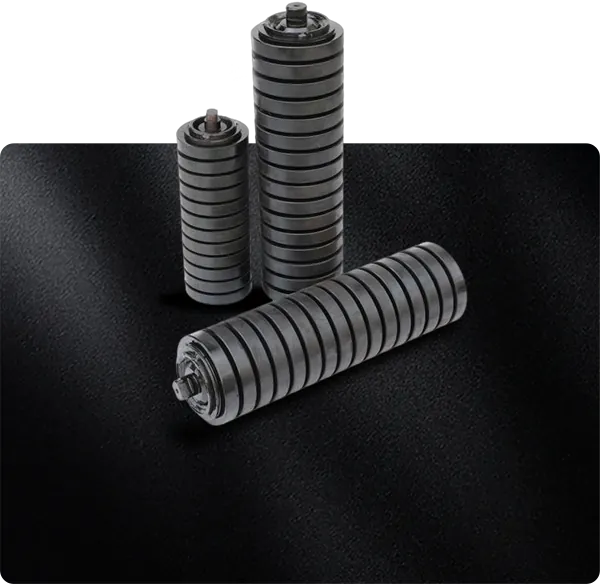
They take the drop energy of the material before the belt absorbs it. That is impact load, not radial load, and it shows up as brinelling and shell damage. The fix is impact idlers with rubber rings or discs at the loading point, plus closer spacing — not a heavier standard roller.
Is a bigger diameter roller always better?
It is better for bearing life, because it lowers rpm for the same belt speed. But it also changes trough geometry, frame height and cost. The right move is to check the rpm first, then decide whether the diameter needs to change — on many uprated conveyors it does.
Should I specify C3 or C4 clearance for conveyor idler bearings?
C3 for almost everything — it is the conveyor default, because it absorbs the interference fit and normal running temperature without the bearing going into preload. Step up to C4 when the duty adds thermal growth C3 cannot take: clinker, sinter or coke; a wide seasonal swing such as a Continental winter; a heavy press fit; or a long overland conveyor in a hot climate. C0/normal belongs only on short, slow, cool flights, and is the usual cause of the preload failure described above.
Does the bearing brand actually matter if the size and clearance are right?
Size and clearance decide most of the life; brand decides the consistency of getting them. On normal duty a quality Chinese bearing (HRB, ZWZ) run at the correct clearance and correct grease will outlast a premium bearing fitted at the wrong clearance. Brand matters most where it changes what your maintenance team can support — if the site already stocks SKF or FAG spares, specify that and remove the substitution risk.
What is the maximum rpm for a conveyor idler?
600 rpm is the general engineering ceiling in most idler standards and design handbooks, but the rating basis is lower: 500 rpm is the CEMA basis speed at which load ratings and rated life are published, so it is the sensible design target. Specific standards and special designs (BOS 613 among them) permit up to 750 rpm where the roller has been designed and rated for it. Past 600 rpm rotational resistance climbs sharply and bearing life falls away — the fix is a larger diameter, not a better bearing.
Why did my rollers fail after the belt speed was increased?
Because roller speed follows belt speed directly, at a fixed diameter. Uprating a conveyor almost always means the existing diameter is now over-speed: the same ø108 mm roller that ran comfortably at 2.5 m/s turns at roughly 620 rpm at 3.5 m/s, past the general limit. This is the most common cause of a sudden wave of failures with no change to the rollers themselves.
What do the CEMA idler classes mean?
The class sets a minimum L10 life at the 500 rpm basis speed, together with the bearing series and shaft-end requirements that go with it. CEMA B is light to medium load in conventional duty; CEMA C is medium load at moderate belt speed; CEMA D is heavy load, and also belongs wherever the position is critical or hard to access; CEMA E/F covers very heavy load and high-impact duty. The life minima group in two steps — B and C at 30,000 hours, D and E/F at 60,000 hours.
Is a higher CEMA class always worth the money?
Not always, but it is more often worth it than the price difference suggests. The class should be chosen by the cost of a change-out, not by the load alone: on an easily accessed in-plant conveyor, CEMA C is usually the right answer, while on a long overland flight, a critical process line, or any position where a change-out means stopping production, the higher class pays for itself the first time it avoids an unplanned stop. Buying a class up to avoid one shutdown is almost always cheaper than the shutdown.
How much damage can one seized roller actually do?
More than its own price by a wide margin on a long conveyor. The belt cover over the seized position is abraded and heated, the shell wears flat, spillage accumulates, and access time along a gallery is billed by the crew and the hour. Add fire risk in coal, biomass and grain handling. On a short in-plant conveyor it is a nuisance; on an overland flight it is an incident.