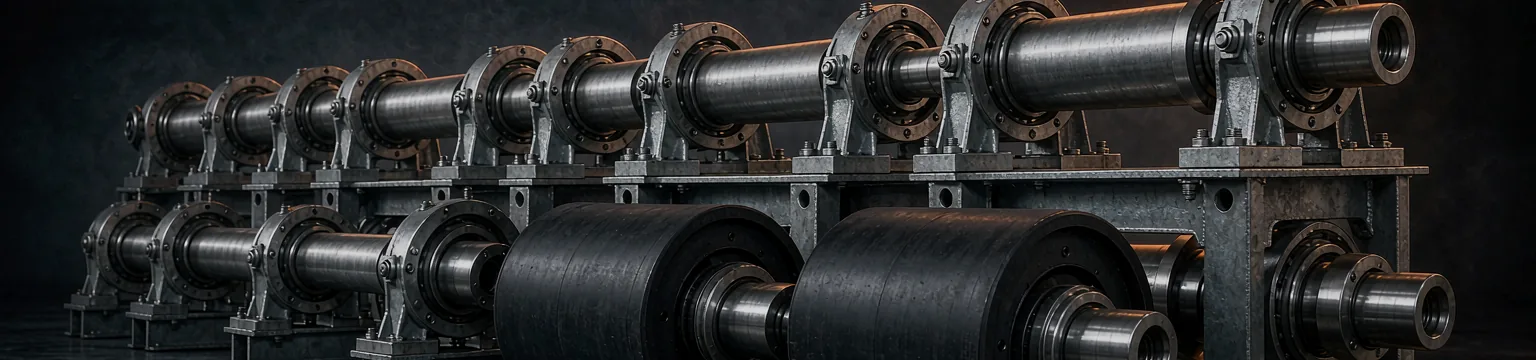
Conveyor Idler vs Roller: What the Difference Means on a Purchase Order
A roller is the part, an idler is the assembly, and a pulley is neither. Why the industry uses all three loosely — and the five numbers that decide what actually shows up.
Key Takeaways
- A roller is the part, an idler is the assembly. The roller is the tube the belt runs on. The idler is that roller plus its shaft, bearings, seals and the way it is retained in the frame.
- Both words are used for the same product every day. "Conveyor roller" and "conveyor idler" are quoted interchangeably across the industry, so the word on its own tells a supplier very little.
- The one distinction that is never blurred is driven vs non-driven. An idler is turned by the belt. A pulley is turned by the drive, or redirects the belt under tension. Nobody calls a drive pulley an idler.
- What removes ambiguity is the drawing, not the terminology. Five numbers — diameter, face length, shaft end, bearing size and seal arrangement — decide what arrives.
The Short Answer
Ask two maintenance engineers what an idler is and you will get two answers. One will say it is the complete unit that drops into the frame. The other will say it is the tube — the thing the belt touches. Both are in everyday use, and both appear on purchase orders. Neither is wrong; they are simply looking at the component from different ends.
The distinction worth holding on to is this:
- A roller, or roll, is the cylindrical body that turns. On its own it is a tube. It becomes a working component once it has a shaft through it, a bearing at each end, and a sealing arrangement keeping contamination out.
- An idler is the assembled non-driven support unit — one or more rollers with their shaft, bearings and seals, and in a troughing set, the frame that holds three rolls at the required angle.
So every idler contains rolls, and not every roll is part of an idler. A drive pulley has a cylindrical shell too, and it is never called a roller, because it is driven.
Why the Words Get Mixed Up
The mixing is not sloppiness. It comes from three legitimate sources.
- Replacement buying. When a roll fails, what is pulled out of the frame and what is ordered is a single roll. Buyers call it a roller. The supplier's catalogue may list the same item under "idler".
- Regional convention. Some markets use "idler" for the whole family and "roller" only for the tube; others reverse the emphasis. Chinese, European and North American catalogues do not agree on where the boundary sits.
- The assembly-and-part overlap. A flat return idler is one roll. A three-roll troughing set is three rolls. Calling the first an "idler" is natural, and the word then carries over to the second.
The practical consequence is that the word on its own carries almost no specification information. Two suppliers quoting a "133 mm idler" can be quoting different shaft ends, different bearings and different seals.
The Distinction That Matters: Driven vs Non-Driven
There is one boundary the industry does not blur, and it is the useful one.
| Idler | Pulley | |
|---|---|---|
| How it turns | Turned by the belt passing over it | Driven by the motor, or redirects the belt under tension |
| What it does | Supports the belt and the load, and controls the belt path | Transmits drive torque, or changes belt direction |
| Specified by | Roll diameter, face length, trough angle, load rating | Shell diameter, face width, shaft diameter, lagging |
| What failure looks like | Seized roll, worn tube, build-up on the shell | Lagging wear, shell cracking, shaft or hub failure |
That is why a conveyor pulley is quoted from a completely different set of parameters, and why a pulley enquiry that arrives labelled as an idler enquiry needs one clarifying email before it can be priced.
What Actually Decides What Arrives
Whatever word you use, these five values are what a supplier needs. Get them right and the terminology stops mattering.
| Value | Why it matters | What to state |
|---|---|---|
| Roll diameter | Sets belt contact, roll rpm and load capacity | Outside diameter in mm. The common standard sizes are 89.1, 114.3, 139.8 and 165.2 mm |
| Face length | Must suit the belt width and the frame it drops into | Length of the cylindrical face — not the overall shaft length |
| Shaft end form | The single most common reason a correct roll does not fit | Shaft diameter plus the end detail: milled flats, spring steel, or threaded |
| Bearing size | Sets load rating and service life | The size you build to, such as 204, 6204, 6205 or 6305, and the brand if your specification names one |
| Seal arrangement | Decides whether the bearing survives the site | The dust, moisture and wash-down regime, or the seal type already in use |
The Types: Which Word Each One Usually Gets
| Type | Usually called | What it does |
|---|---|---|
| Carrying / troughing | Idler — a set of three rolls | Supports the loaded belt and forms the trough |
| Return | Roller or idler | Supports the empty belt on the return strand |
| Impact | Impact idler or impact roller | Absorbs loading-point shock through rubber rings |
| Self-aligning / training | Idler | Steers a drifting belt back to centre |
| Spiral | Roller | Sheds sticky material on the return side |
| Rubber disc | Roller | Reduces build-up on the return side |
| Garland | Idler set | Three rolls linked and hung, following the belt profile |
All of these are non-driven, and all of them are built from the same five values above. Whether a catalogue calls them rollers or idlers, the enquiry is answered the same way.
Why This Matters More When You Buy Across Borders
Buying locally from a catalogue you have used for years, the word is enough — the part number behind it carries the specification. Sending an enquiry to a factory that has never seen your conveyor, the word carries nothing.
That is the real cost of the terminology confusion: not the argument, but the round of emails that follows it. A request that says "200 idlers, 133 mm" comes back with questions about face length, shaft ends and bearings. The same request with a dimension sketch, or a photograph of the worn roll beside a tape measure, gets quoted the same day.
Our builds span 50–219 mm diameter and 190–3400 mm length, with 89.1, 114.3, 139.8 and 165.2 mm as the standard diameters and 204, 6204, 6205 and 6305 as the usual bearing sizes — and anything outside that range is built to drawing. The full range against belt width is in the conveyor idler specification table, and the standards these dimensions are checked against are covered in CEMA, DIN, GB, JIS and BS explained.
FAQ
Is a conveyor roller the same thing as a conveyor idler?
In most enquiries, yes — the two terms are used for the same product. Strictly, the roller is the rotating cylindrical part and the idler is the assembled support unit that contains it. What matters on an order is the dimension set behind the word, not which word you choose.
Is a pulley a type of idler?
No. Idlers are turned by the belt; pulleys are driven, or redirect the belt under tension. They are quoted from different parameters — roll diameter and face length for an idler, shell diameter, face width and shaft diameter for a pulley — and they are manufactured as different product families.
Which word should I use in an enquiry?
Either is understood. What speeds up the quotation is attaching the roll diameter, face length, shaft end detail and quantity, or a photograph of the existing part with measurements marked on it.
Can you match a roller I already have but have no drawing for?
Yes. Send one worn roller and the shaft ends, face length, bearing seat and seal arrangement can all be measured from it. Tell us which dimensions are critical — usually the shaft end and the face length rather than the tube diameter.
Do you supply the frames as well as the rolls?
Yes — carrying, return and impact frames, plus stringers. Ordering rolls and frames together is the safer route, because the face length only works if the frame series matches.
How long does an idler last once fitted?
It depends far more on the seal, the load and the environment than on the roll itself. The published life figures are bearing ratings calculated at a reference speed and load, and contamination usually ends a roll before fatigue does — see how long a conveyor idler should last.
Send Us Your Duty — We Will Return a Build
Belt width, speed, material, tonnage, temperature and environment. We come back with the build, drawings and a quotation.
Related Guides
How Long Should a Conveyor Idler Last?
A conveyor idler rated at 30,000 hours rarely reaches it. What the L10 figure actually measures, the four factors that cut it, and the symptoms worth replacing on.
Why Your Conveyor Belt Runs Off Centre: 9 Causes, in the Order to Check Them
A belt does not wander; it is steered. Find the cause in the right order — build-up, loading point, structure, pulleys, idlers, camber, splice, tension — before touching an idler.
How to Measure a Conveyor Roller for Replacement — Without the Drawing
The drawing is gone and the line is down. Six measurements and one photo define a roller completely — here is how to take them and what to send with the enquiry.
Where to Go Next
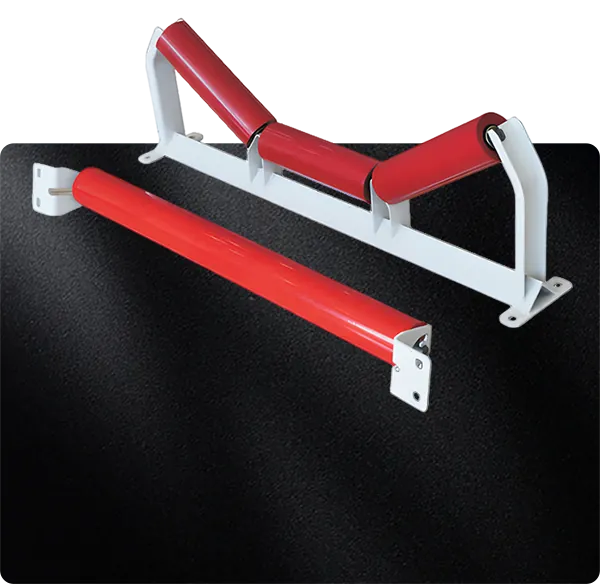
Troughing Idler
Carrying-side support, 20°/35°/45° trough angles.
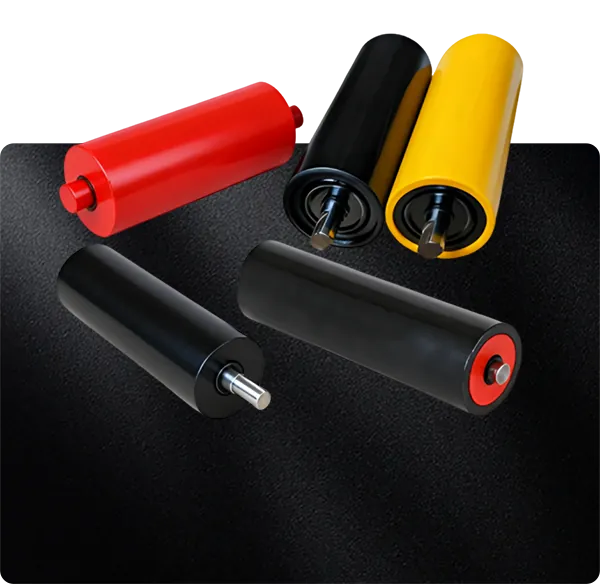
Carrying / Return Idler
Flat carry and return duty, standard and heavy-wall tube.
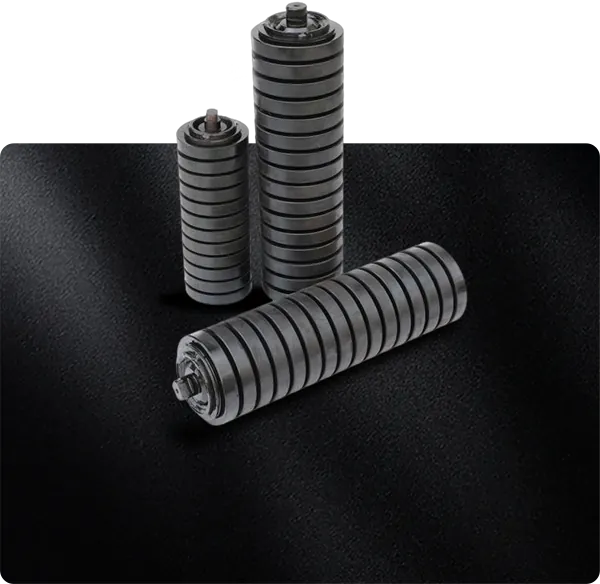
Impact Roller
Rubber-ring cushioning at the loading point.
Conveyor Pulleys
Drive, bend, tail & snub pulleys — with rubber, ceramic or herringbone lagging to your spec.
Conveyor Belts
EP/NN, steel cord, heat, oil and abrasion resistant covers. 17 types for different duties.
Cleaners & Impact Beds
Belt cleaners, impact beds, skirt seals — the parts that decide whether your idlers survive.