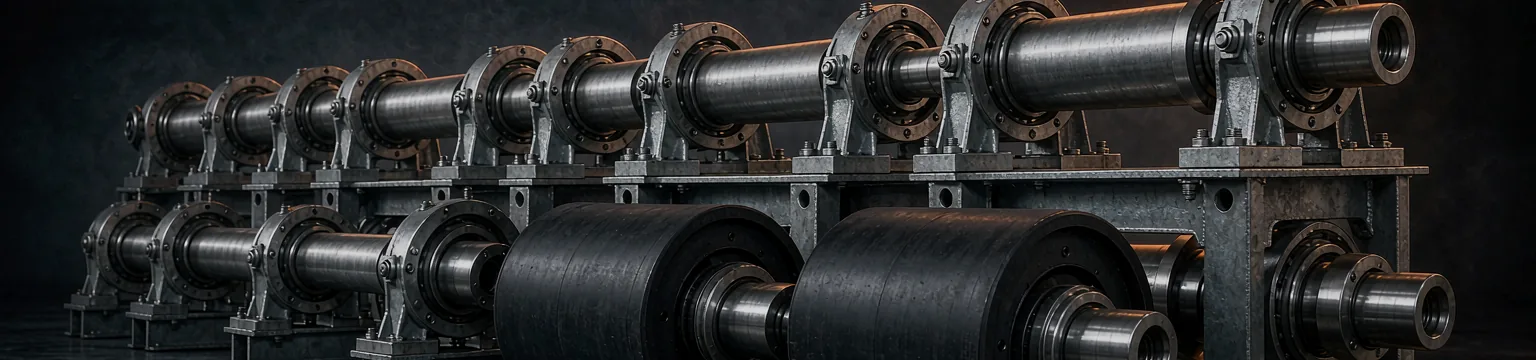
How Long Should a Conveyor Idler Last?
A conveyor idler rated at 30,000 hours rarely reaches it. What the L10 figure actually measures, the four factors that cut it, and the symptoms worth replacing on.
Key Takeaways
- The published life figure is a bearing rating, not a promise about the roller. L10 is calculated at a rated load and a reference speed of 500 rpm, under clean lubrication.
- Idler life is usually ended by contamination, not by fatigue. The bearing rarely reaches its fatigue limit — the seal fails first, or the tube wears through.
- The rating assumes conditions your site may not have. Load, maintenance, environment and temperature are applied as correction factors because each one moves the answer more than the bearing choice does.
- Replacement should be triggered by inspection findings, not by the calendar. Five symptoms are worth acting on; three are not.
What the Life Figure Actually Means
When a specification quotes an idler life, it is almost always quoting a bearing L10 life. L10 is the number of operating hours that 90% of a large batch of identical bearings will reach or exceed before fatigue appears on a ring or a rolling element. It is calculated at a rated load, a reference speed of 500 rpm, and clean lubrication.
On that basis the CEMA classes carry minimum L10 ratings of 30,000 hours for CEMA B and C, and 60,000 hours for CEMA D, E and F. Those are minimums, and individual manufacturers publish higher figures for particular series and belt widths.
Two things follow immediately.
- The figure is about the bearing, not the roller. The rating system uses bearing life because it is the only variable with standard laboratory values behind it. The seal, the tube wall and the shaft condition usually decide the answer first.
- The figure assumes a duty your conveyor may not run. L10 at 500 rpm is not L10 at 750 rpm, and neither is L10 under impact loading at a crusher discharge.
For how these ratings sit alongside the other frameworks, see CEMA, DIN, GB, JIS and BS explained.
The Four Factors That Cut It
The rating frameworks apply correction factors for exactly these reasons, and they move the number further than the bearing selection does.
| Factor | What it does to life | Where it bites hardest |
|---|---|---|
| Load — including idler misalignment load | Bearing life falls with the cube of the load, so a modest overload costs a large amount of life | Frames at differing heights, stringers out of level, mixed idler types in one run |
| Maintenance — whether anyone looks | A seized roll left running loads its neighbours, which then fail in turn | Long conveyors with infrequent inspection; enclosed or elevated runs |
| Environment — dust, moisture, wash-down | Contamination ends bearings long before fatigue does | Cement kiln dust, salt-spray port air, wet ore, regular wash-down |
| Temperature — ambient and material | Heat thins the grease and shortens its life, and calls for a larger internal clearance | Clinker, sinter, coke, and any duty with hot material |
Speed: The Quiet One
Roll rpm is set by belt speed and roll diameter, and the ratings are calculated at 500 rpm. A smaller roll on a faster belt spins faster than the reference, and the hours come down accordingly. This is why a diameter that looks oversized on a slow conveyor is correct on a fast one, and why belt speed belongs in the enquiry.
It is also where the practical speed limits come from. Our own builds are rated on the CEMA 500 rpm basis, with 600 rpm as the general limit and 750 rpm treated as a special design — above that, the diameter and the bearing selection both have to change.
What Actually Ends a Roller
| Failure | What you see | What caused it |
|---|---|---|
| Seized roll | Roll stops turning, the belt slides over it, a flat spot is worn into the tube | Contamination or dried grease — see why idler bearings seize before they wear out |
| Worn-through tube | Tube wall thinned, usually on the carrying side beneath the loading point | Sliding abrasion from fines; wall thickness too light for the duty |
| Build-up on the shell | Material packed onto the roll face, belt starting to wander | Sticky material with nothing cleaning the return side; wrong roll type for the duty |
| Noisy or rough roll | Audible rumble, vibration felt on the frame | Bearing damage in progress — the cheapest point to intervene |
| Bent or broken shaft | Roll hanging out of line | Impact beyond the rating, or a seized roll levered on its shaft end |
Three of those five are contamination-driven, which is why the seal specification is usually a stronger lever on service life than the bearing size. Our sealing stack — grease inner seal, multi-stage labyrinth and retention cap — is built for that reason; the detail is on the conveyor idler page.
When to Replace: The Inspection Triggers
Calendar-based change-outs waste good rolls and still miss bad ones. These are the findings worth acting on:
- Any roll that has stopped turning. It is no longer supporting the belt; it is being dragged across it, and it will damage the belt cover.
- A flat spot on the tube. Once a roll has been dragged it will not run true again.
- Audible bearing noise. The stage before seizure. Replacing here costs one roll and a few minutes.
- Measured tube wear through the wall. On the carrying side under a loading point this is the expected end of life for that duty, not a defect.
- A run of failures in one section. Three rolls failing in the same hundred metres is not three roll failures — it is a load, alignment or sealing problem in that section.
What is not a trigger on its own: surface rust that has not pitted, cosmetic coating damage, and a roll that is simply older than its neighbours. Replace on condition, and keep the condition measurable.
Spot Replacement or Full Change-Out?
| Spot replacement | Full change-out | |
|---|---|---|
| Choose when | Failures are scattered and isolated | Failures cluster in a section, or the whole run is of one age |
| Advantage | Lowest immediate cost; no shutdown planning | One shutdown instead of many; the run then ages together |
| Watch out for | New rolls sitting between tired ones and inheriting the alignment problem | Discarding rolls that still have useful life |
| Usually right for | Long overland conveyors, accessible runs | Short conveyors, problem sections, planned shutdown windows |
Whichever route is taken, revisit the specification at the same time. If the same section keeps consuming rolls, ordering the identical roll again reproduces the failure: the diameter, the wall thickness, the seal arrangement or the frame condition is what has to change.
What We Need to Quote a Life Figure for Your Duty
A life figure only means something against your numbers. Send these and the calculation comes back with the quotation:
- Belt width, belt speed and material bulk density
- Idler spacing and trough angle
- Roll diameter and the bearing size you are running now
- Environment: dust type, moisture, wash-down, ambient and material temperature
- What is failing today, and how many hours it lasted
The last one is the most useful. Knowing how long the current rolls actually lasted, and which section they came from, says more about your duty than any standard table does.
FAQ
What does L10 life mean on a conveyor idler?
L10 is the operating life that 90% of a batch of identical bearings will reach or exceed under a defined load and speed before fatigue appears. CEMA sets idler load ratings on a minimum L10 at a 500 rpm reference: 30,000 hours for CEMA B and C, 60,000 hours for CEMA D, E and F.
Why do my rollers not last as long as the rating?
Because the rating is a bearing fatigue figure calculated at rated load and reference speed under clean lubrication. Real conveyors add misalignment load, contamination, wash-down and temperature, and the rating frameworks apply a correction factor for each. Contamination, not fatigue, ends most rollers.
What is the most common cause of early idler failure?
Bearing contamination, followed by misalignment load from rolls that are not level with their neighbours. The seal specification and the frame condition are usually more effective levers than increasing the bearing size.
Should I replace idlers on a schedule?
Condition beats calendar. Seized rolls, flat-spotted tubes, audible bearing noise and measured wall loss are worth acting on. Surface rust and age alone are not.
Do larger rolls always last longer?
Not automatically. A larger diameter reduces roll rpm for a given belt speed and raises the load rating, which both help — but if the failures are contamination-driven, changing the seal arrangement does more than changing the diameter. Look at how the rolls are failing before changing the size.
Can I get a life figure for my specific conveyor?
Yes. Send belt width, belt speed, material density, idler spacing, trough angle, the roll and bearing size in use, and the environment — plus how long your current rolls lasted. The calculation comes back with the quotation.
Send Us Your Duty — We Will Return a Build
Belt width, speed, material, tonnage, temperature and environment. We come back with the build, drawings and a quotation.
Related Guides
Conveyor Idler vs Roller: What the Difference Means on a Purchase Order
A roller is the part, an idler is the assembly, and a pulley is neither. Why the industry uses all three loosely — and the five numbers that decide what actually shows up.
Why Your Conveyor Belt Runs Off Centre: 9 Causes, in the Order to Check Them
A belt does not wander; it is steered. Find the cause in the right order — build-up, loading point, structure, pulleys, idlers, camber, splice, tension — before touching an idler.
How to Measure a Conveyor Roller for Replacement — Without the Drawing
The drawing is gone and the line is down. Six measurements and one photo define a roller completely — here is how to take them and what to send with the enquiry.
Where to Go Next
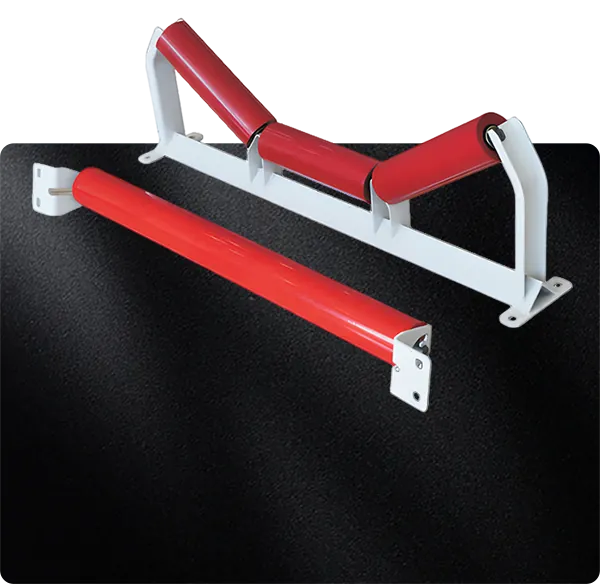
Troughing Idler
Carrying-side support, 20°/35°/45° trough angles.
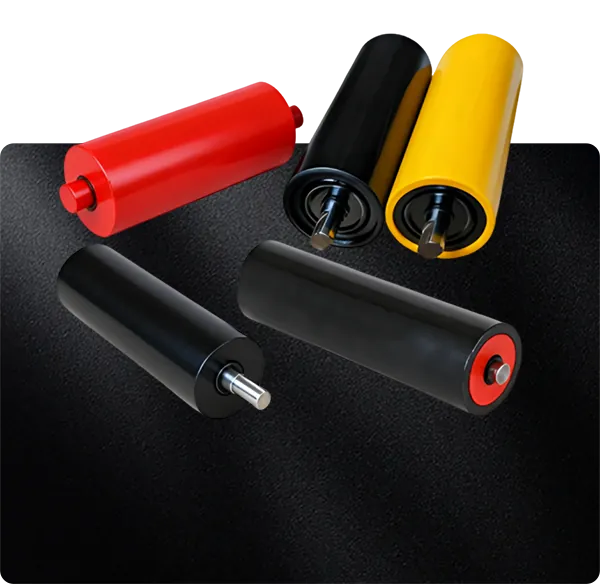
Carrying / Return Idler
Flat carry and return duty, standard and heavy-wall tube.
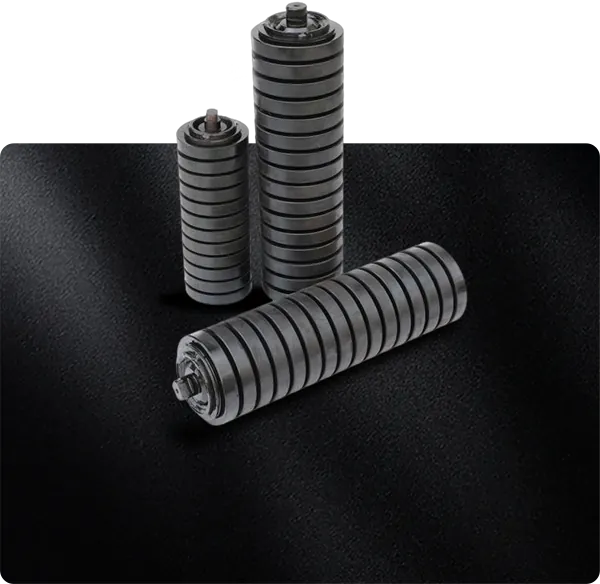
Impact Roller
Rubber-ring cushioning at the loading point.
Conveyor Pulleys
Drive, bend, tail & snub pulleys — with rubber, ceramic or herringbone lagging to your spec.
Conveyor Belts
EP/NN, steel cord, heat, oil and abrasion resistant covers. 17 types for different duties.
Cleaners & Impact Beds
Belt cleaners, impact beds, skirt seals — the parts that decide whether your idlers survive.